A Respected Manual, Built for a Different Job
The Red Cross name carries real weight, and for good reason. Its Comprehensive Guide for First Aid & CPR, published by the Canadian Red Cross, is a solid, well-organized manual that many people download or receive with a first aid course.
So if you already have it, do you still need Survival MD by Dr. Radu Scurtu?
To answer that, we went through the Red Cross guide (2025 edition) section by section and compared it with Survival MD. The two books share some topics, but they're built for two very different moments:
- The Red Cross guide is built for the minutes until emergency services arrive. In its own words: "Once you start giving first aid, keep providing help until EMS personnel arrive."
- Survival MD is built for the hours and days when you can't reach a doctor at all, because EMS isn't coming.
That difference decides almost every category below.
The Comparison at a Glance
| Red Cross Comprehensive Guide for First Aid & CPR | Survival MD | Winner | |
|---|---|---|---|
| Built for | Supporting first aid training, care until EMS arrives | Situations where no doctor or EMS can reach you | ✅ Survival MD |
| Core method | Check, Call, Care | Assess, decide and care, with no one to call | ✅ Survival MD |
| Written for | Canadian readers: provincial laws, a Canadian poison number, Canadian kit standards | American families | ✅ Survival MD |
| Chronic disease over days or weeks | Not covered | A full chapter with color-coded action zones | ✅ Survival MD |
| Medication stockpiling and rotation | Not covered | Full chapters, plus surviving without prescriptions | ✅ Survival MD |
| Dental emergencies | Knocked-out teeth | A full chapter: toothache, swollen jaw, broken jaw, oral injuries and more | ✅ Survival MD |
| Water, sanitation, infection over days | Limited | Full chapters on sanitation, waterborne, foodborne and airborne illness | ✅ Survival MD |
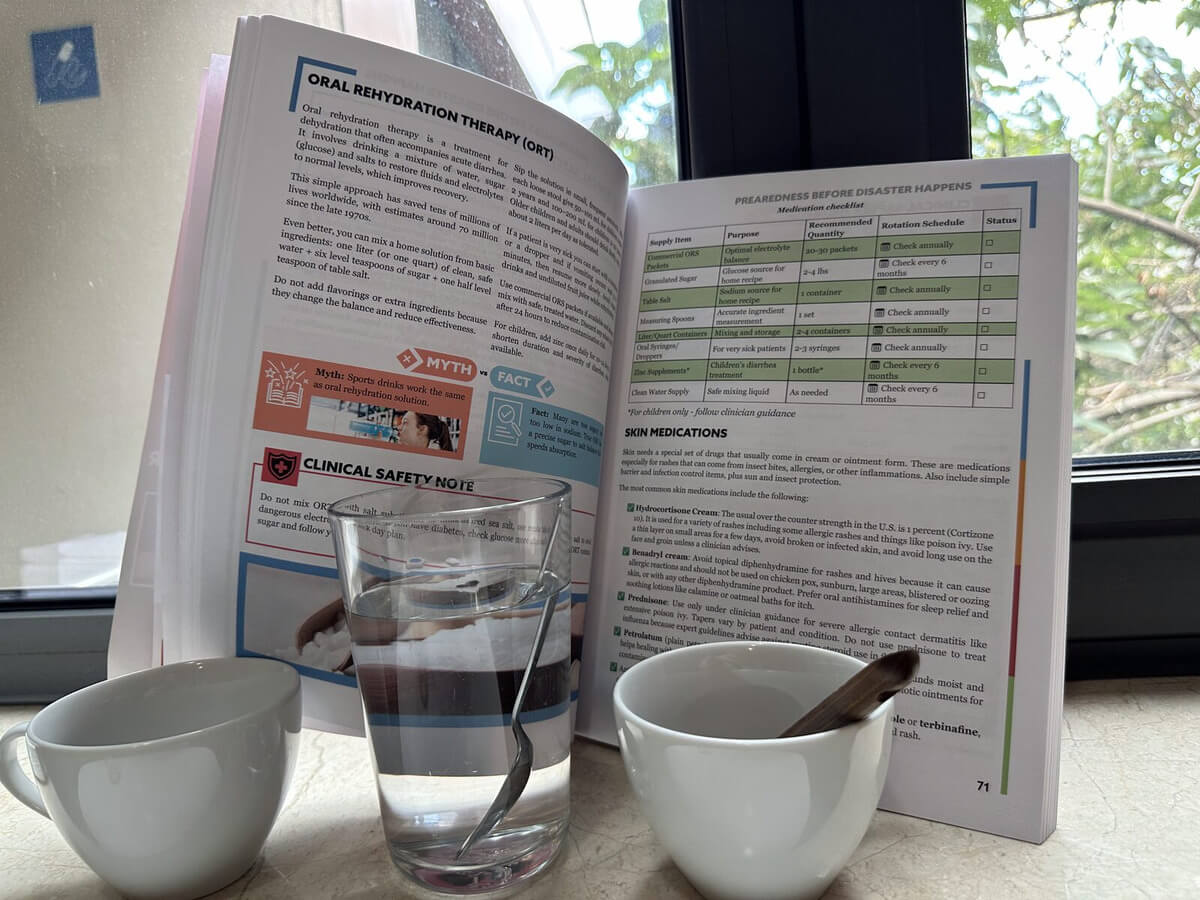
| Myth-busting | No Myth vs. Fact boxes | 70 Myth vs. Fact boxes, 50+ Clinical Safety Notes | ✅ Survival MD |
| References | A short list, largely Canadian workplace and legal sources | 350+ medical references, many from 2024 and 2025 | ✅ Survival MD |
| Home supply planning | A basic kit contents list | A 147-item home inventory with quantities for 2 adults + 1 child for 30 days | ✅ Survival MD |
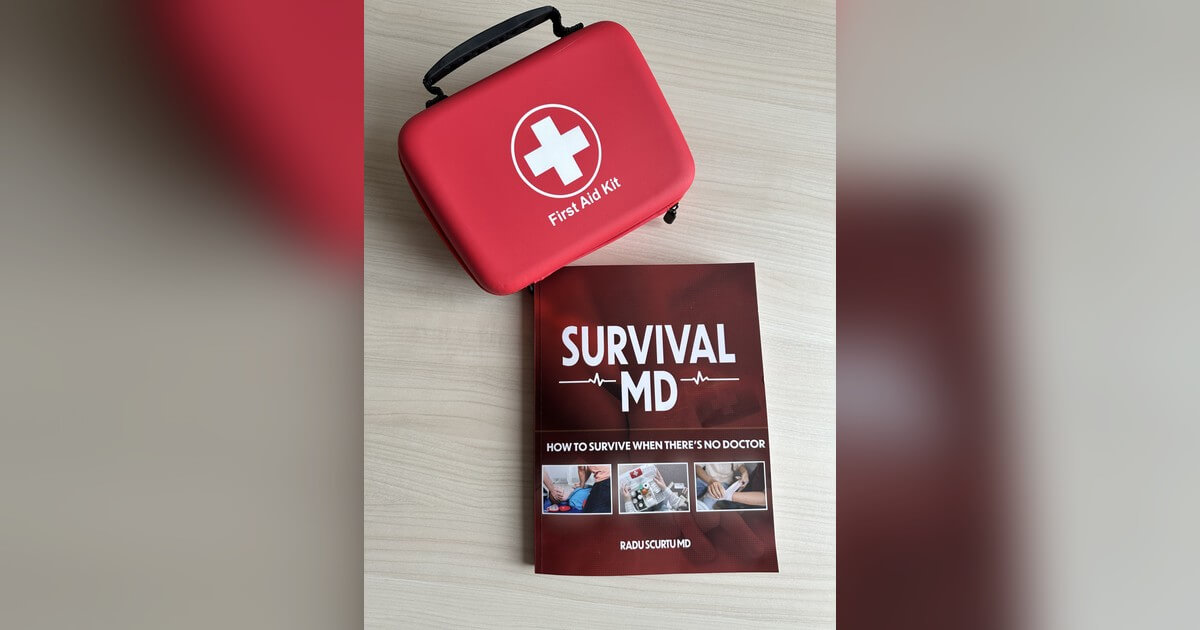
| Format | Digital PDF, about 260 pages | 288-page, full-color printed book | ✅ Survival MD |
1. "Check, Call, Care" Assumes Someone Answers the Call
The Red Cross guide is organized around its well-known method: Check, Call, Care. Check the scene and the person, call EMS/9-1-1, then care for the person until help arrives. Whole sections explain how to activate EMS, when to call 9-1-1 and your role in the EMS system.
That's exactly right on a normal day. But in a hurricane, a flood, an ice storm or a grid collapse, the "Call" step may fail: lines jammed, roads blocked, responders overwhelmed. The guide only briefly touches on delayed EMS, mainly when discussing whether to move someone with a head, neck or spine injury.
Survival MD starts where "Call" fails. Its entire second section, "Medical Preparedness After D-Day," is built for when no one is coming. It covers:
- What to do when there is no doctor around
- The TeCaMoLo Principle, four questions to understand any injury
- How to recognize signs of medical distress and perform a body check
- Self-diagnosis and keeping sterile conditions at home
- "Moment X": deciding who to help first when several people are hurt
Winner: Survival MD.
2. Written for Canada, Not for Your Family
The Red Cross guide we reviewed comes from the Canadian Red Cross, and it shows. It refers to provincial and territorial legislation, Canadian workplace first aid rules, the Canadian national poison number and Canadian Standards Association kit standards.
That's helpful for Canadian workplaces. For an American family, it means some of the practical details, like legal guidance, kit standards and phone numbers, don't apply where you live.
Survival MD is written for American families, built on U.S. sources like the CDC, FDA, NIH, American Heart Association, American Red Cross, FEMA and Ready.gov.
Winner: Survival MD.
3. Chronic Disease and Medications: Not in the Red Cross Guide
This is the biggest gap. The Red Cross guide handles sudden medical emergencies well: diabetic emergencies, seizures, asthma attacks, heart attack and stroke. But it doesn't cover what happens over days and weeks when someone with a chronic condition is cut off from their doctor and pharmacy.
It doesn't cover:
- Managing diabetes, heart disease, lung disease or kidney disease through a long emergency
- Which medications to stockpile and how to rotate them
- What to do when prescriptions run out
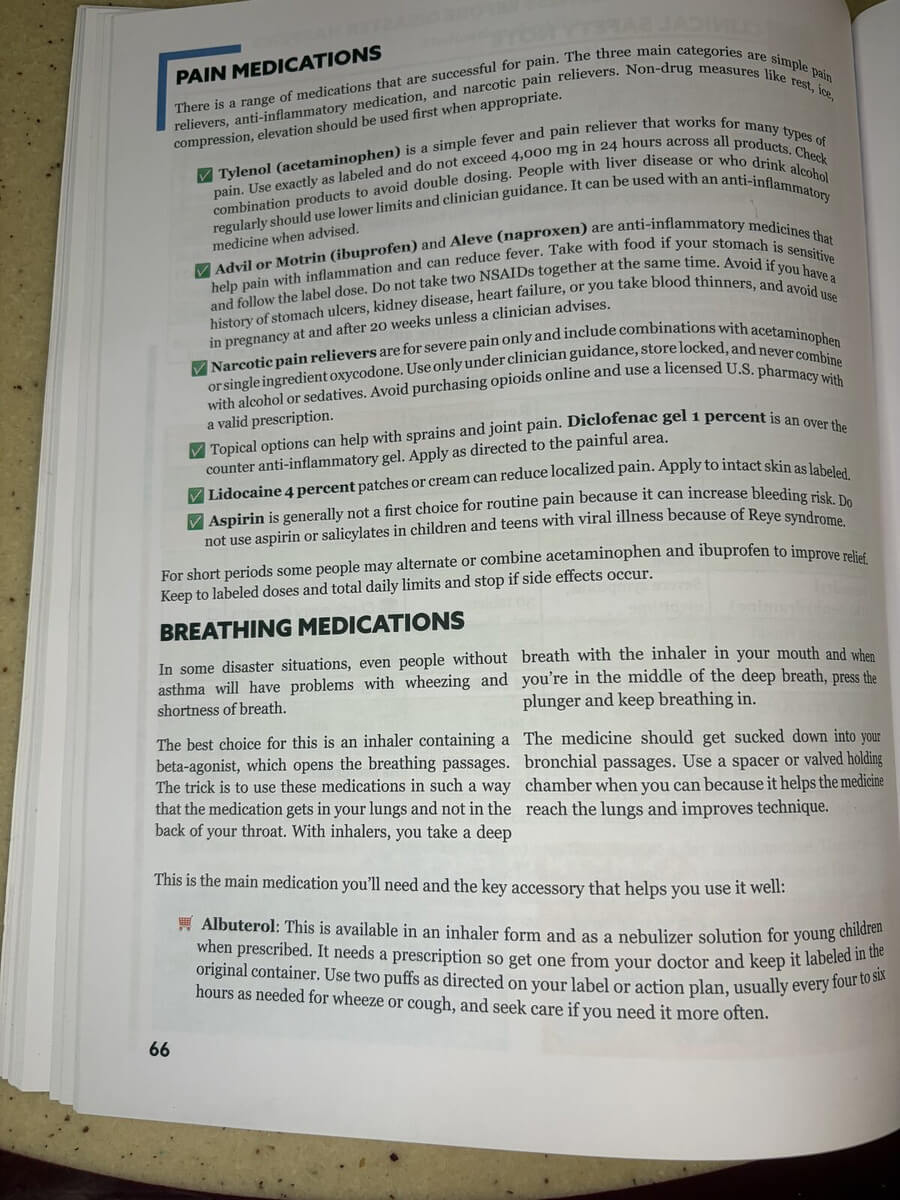
Survival MD covers all three. Its Specific Disease Preparedness chapter covers conditions by body system (nervous, respiratory, circulatory, digestive, urinary and metabolic), each with color-coded zones showing what each stage means, which supplies to keep and what to do. It adds chapters on medications to stockpile, a medication rotation system and how to survive without prescriptions, with firm safety rules: no self-tapering, antibiotics only with a clinician's written plan, and never veterinary antibiotics for people.
Winner: Survival MD.
4. The Topics a First Aid Manual Leaves Out
The Red Cross guide covers what a first aid course covers: choking, CPR and AED, breathing emergencies, wounds, burns, head and spine injuries, bone and joint injuries, sudden illness, heat and cold, drowning, poisons, childhood illnesses and caring for children. It's thorough within that scope.
But a long emergency brings problems outside it:
- Dental emergencies: the Red Cross guide covers knocked-out teeth. Survival MD has a full chapter on toothache, swollen jaw, oral injuries, prolonged bleeding after an extraction, broken jaw and more.
- Infections over days: Survival MD covers foodborne, waterborne and airborne illnesses, and the signs that an infection is getting worse.
- Sanitation without running water: toilets, waste and handwashing stations.
- Women's health and pregnancy when no clinic is open.
- Natural options for 14 common problems, with safety flags.
- Climate-specific risks and radiation exposure.
Winner: Survival MD.
5. Myths, Safety and Sources
The Red Cross guide gives clear, step-by-step first aid. But it doesn't include Myth vs. Fact boxes, and its references section is short, made up largely of Canadian workplace, standards and legal sources.
Survival MD goes further on both:
- 70 Myth vs. Fact boxes that correct the "home remedies" people reach for in a panic
- 50+ Clinical Safety Notes that stop common, dangerous mistakes
- 350+ references to sources like the CDC, FDA, NIH, Cochrane reviews and the American Heart Association, many published in 2024 and 2025
Winner: Survival MD.
6. Supplies: A Kit List vs. a Household Plan
The Red Cross guide includes a list of what a first aid kit should contain, plus an appendix on kit contents. It's a good basic list.
Survival MD builds a complete household medical plan:
- A 147-item home medical inventory with quantities for 2 adults + 1 child for 30 days
- The Lifeline Kit, with core medications and medical and hygiene modules
- Response packs for superficial wounds, sutures or staples, and complicated wounds and fractures
- Kit lists for a basic and comprehensive first aid kit, a bug-out bag and a bug-out vehicle
Winner: Survival MD.
7. Format: A PDF vs. a Book on Your Shelf
The Red Cross guide is mainly used as a digital PDF of about 260 pages. That's convenient on a normal day. But in a disaster, a PDF needs a charged device, and your phone has more important jobs, like calling for help and reaching family.
Survival MD is a 288-page, full-color printed book on large 11 x 8.5 inch pages. It works with no power, no internet and no signal, and anyone in the house can pick it up. More here: Why "I'll Just Google It" Fails in a Real Emergency
Winner: Survival MD.
The Final Score
| Category | Winner |
|---|---|
| Built for when help isn't coming | ✅ Survival MD |
| Written for American families | ✅ Survival MD |
| Chronic disease and medications | ✅ Survival MD |
| Topics beyond basic first aid | ✅ Survival MD |
| Myths, safety and sources | ✅ Survival MD |
| Household supply planning | ✅ Survival MD |
| Works without power | ✅ Survival MD |
The Red Cross guide is a good companion to a first aid course. But it's built for the minutes before professionals take over. For the days when they can't, Survival MD is the book your family needs.
Should You Keep the Red Cross Guide?
Sure, especially if you've taken a Red Cross course and want to review what you practiced. But don't mistake it for a disaster plan. It ends where Survival MD begins.
The smart setup:
- Survival MD on your shelf, next to your first aid kit, as your family's main medical reference for when no doctor can be reached.
- A hands-on first aid and CPR class for practice. Survival MD itself recommends an accredited CPR class. More here: Book vs. Red Cross Class: Do You Need Both?
What You Get for $37
- Survival MD, the full-color printed book: 288 pages, 19 chapters, 150+ topics
- 4 bonus guides: When There's No Doctor For Your Child, When There's No Pharmacy, Herbal First Aid For When There's No Doctor and When There's No Vet
- A 60-day refund: your money back within 5 business days, and you keep everything
Frequently Asked Questions
What's the difference between Survival MD and the Red Cross first aid manual?
The Red Cross Comprehensive Guide for First Aid & CPR is built to support first aid training and care until EMS arrives. Survival MD is built for when you can't reach a doctor or EMS at all, covering chronic disease, medications, infections, sanitation, dental emergencies and long-term care.
Is the Red Cross first aid guide enough for disaster preparedness?
It's a good resource for the first minutes of an emergency. But it doesn't cover chronic disease management, medication stockpiling or what to do when help can't come for days. Survival MD does.
Is the Red Cross guide written for Americans?
The Comprehensive Guide for First Aid & CPR is published by the Canadian Red Cross and refers to Canadian legislation, a Canadian poison number and Canadian kit standards. Survival MD is written for American families.
Does Survival MD cover CPR and basic first aid too?
Yes. It covers CPR for adults, children and babies, choking, bleeding, wounds, burns, fractures and shock, then goes far beyond basic first aid.
How much does Survival MD cost?
$37 for the full-color printed book, with 4 bonus guides and a 60-day refund in which you keep everything.
The Bottom Line
The Red Cross first aid manual does its job well: teaching the first minutes of care until EMS arrives. Survival MD does the job that comes next: helping your family through the hours and days when no doctor or ambulance can reach you. With chronic disease plans, medication guidance, 350+ current references, a 147-item household inventory and a full-color printed format, it's the book built for a real disaster.