Two Books, One Mission, Very Different Results
If you've researched medical preparedness, you've probably come across The Survival Medicine Handbook by Joseph Alton, MD and Amy Alton, APRN, known to many preppers as "Dr. Bones and Nurse Amy." It's been around for years, it's now in its fourth edition, and it's often the first title people find.
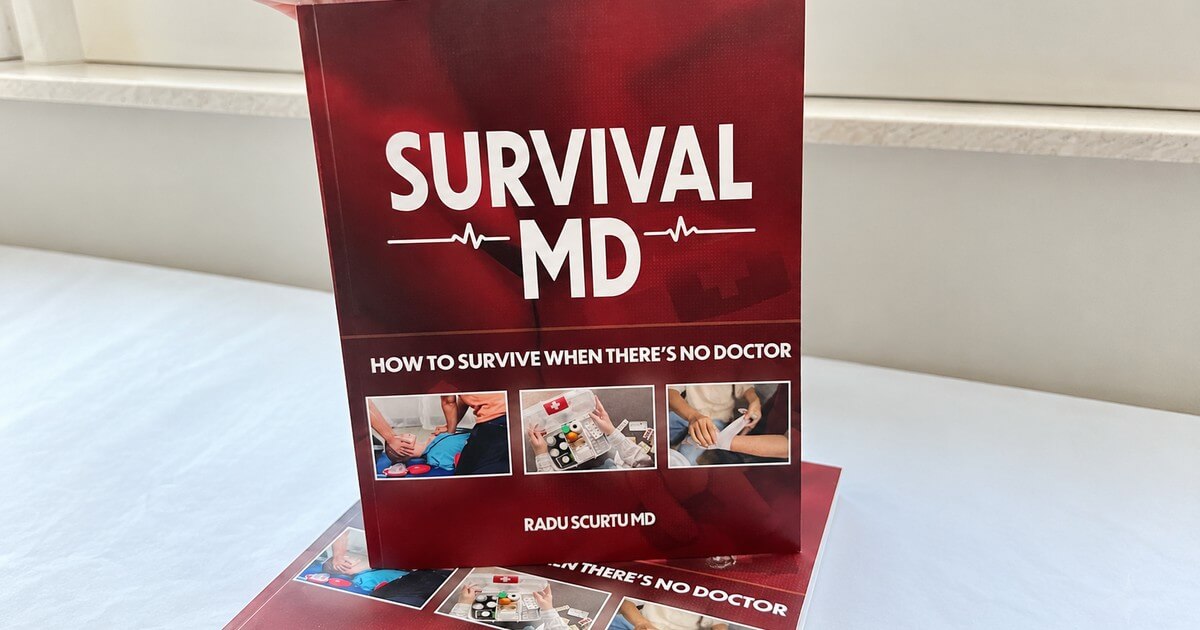
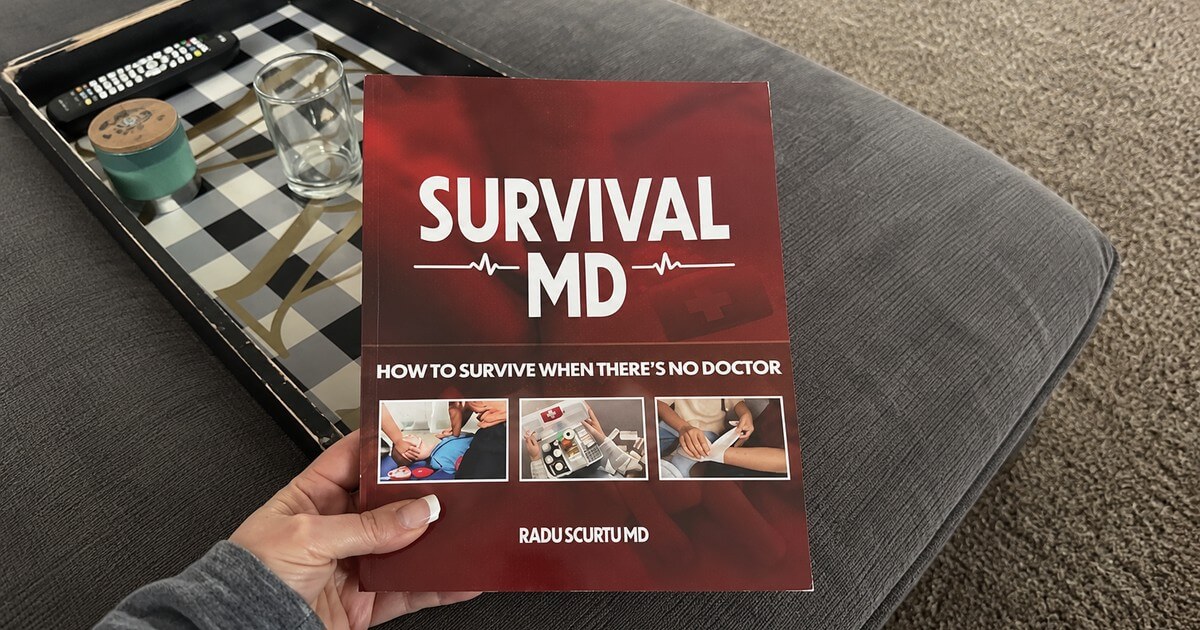
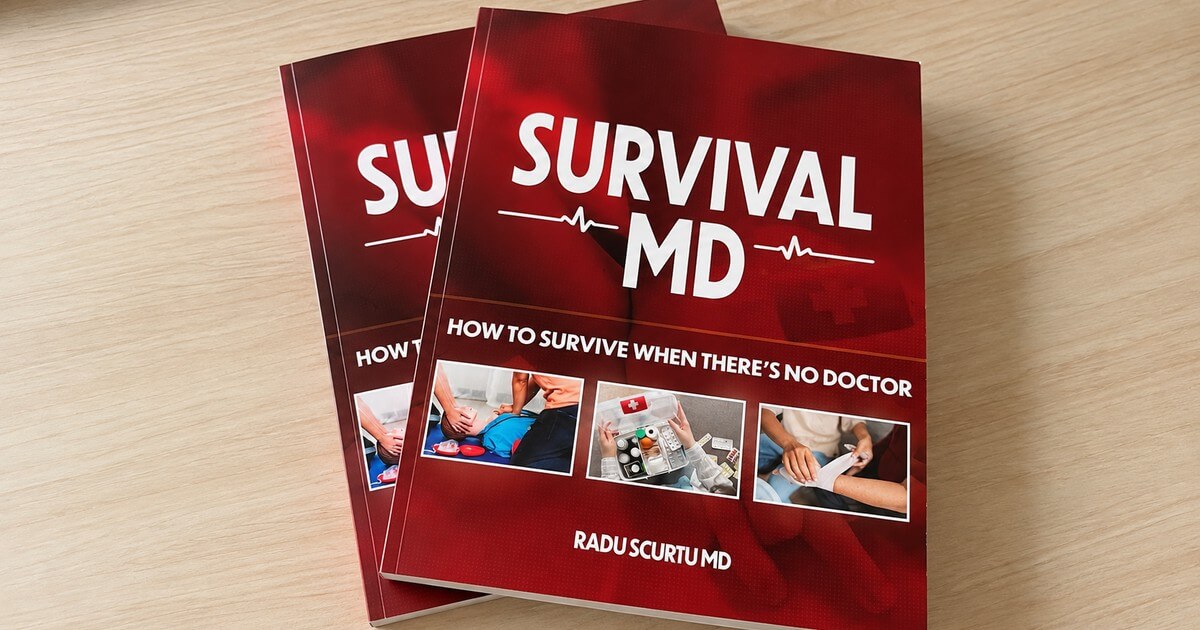
Survival MD by Dr. Radu Scurtu was built for the same moment: the day a disaster cuts you off from doctors and hospitals and you can't reach professional care at all.
Same mission. But when you put them side by side, category by category, the question isn't which book contains more pages. It's which book will actually help your family when someone is hurt or sick and nobody is coming. On that question, Survival MD wins.
The Comparison at a Glance
| The Survival Medicine Handbook (4th ed.) | Survival MD | Winner | |
|---|---|---|---|
| Usable under stress | About 672 pages of mostly text, 35 sections | 288 focused pages, 19 chapters, 150+ topics | ✅ Survival MD |
| Format | Some black-and-white photos and illustrations | Full color on every page, 11 x 8.5 inches | ✅ Survival MD |
| Decision tools | Text-based explanations | 8 flowcharts, color-coded zones, 70 Myth vs. Fact boxes, 50+ Clinical Safety Notes | ✅ Survival MD |
| Sources | A glossary and 20+ references for further reading | 350+ references, many from 2024 and 2025 | ✅ Survival MD |
| Medication safety | An extensive antibiotics section | A clinician's written plan, never veterinary antibiotics, no self-tapering | ✅ Survival MD |
| Chronic disease | Covered by body system; reviewers noted the heart section lacks depth | A full chapter with color-coded action zones for each body system | ✅ Survival MD |
| Natural remedies | Large volume of oils, products and recipes | Herbal options for 14 common problems, with safety flags and myth-busting | ✅ Survival MD |
| Household supply plan | Kits from a medic bag up to a field hospital | A 147-item home inventory with quantities for 2 adults + 1 child for 30 days | ✅ Survival MD |
| Extras | None | 4 bonus guides and a 60-day refund, keep everything | ✅ Survival MD |
Handbook details are based on Off-Grid magazine's published reviews of its third and fourth editions (see Sources below).
1. Usability: Built to Be Used, Not Just Read
The Handbook is big: about 672 pages across 35 sections. Off-Grid magazine's review of the third edition called the length "a little daunting," and its fourth-edition review noted it's too long for a bug-out bag. Reviewers of both editions wished for more photos and illustrations, and the third-edition review pointed out that they're black and white.
That's a problem in a real emergency. When someone is bleeding, burning with fever or struggling to breathe, nobody has time to search through hundreds of pages of text.
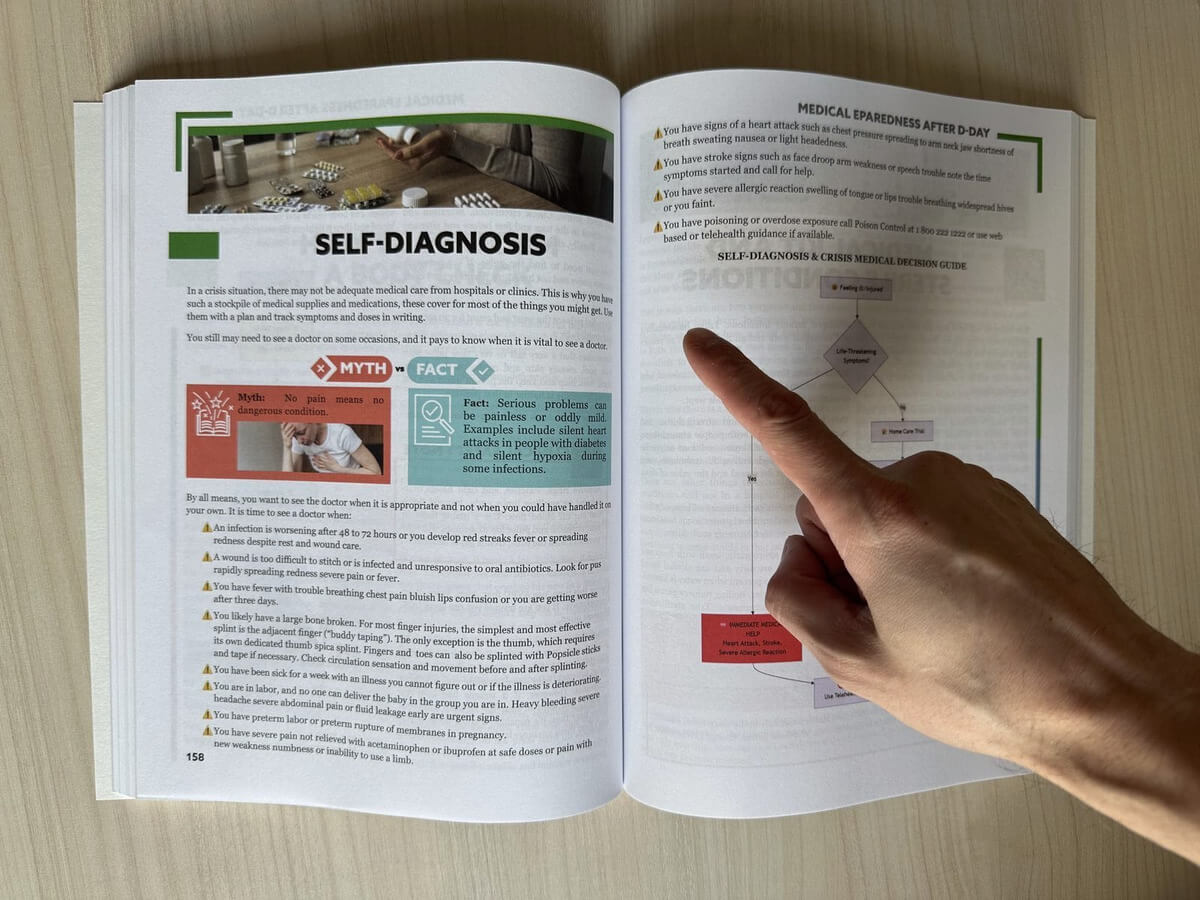
Survival MD solves this. It's 288 focused pages, printed in full color on large 11 x 8.5 inch pages, so the right information jumps off the page. Color photos, colored warning boxes and color-coded charts guide your eye straight to what matters.
Winner: Survival MD. A book is only as good as your ability to use it under stress.
2. Decision Tools: Survival MD Tells You What to Do Next
The Handbook mostly explains: it's a text reference you read and absorb.
Survival MD is built to guide decisions, with tools designed for a stressed, non-medical reader:
- 8 flowcharts for decisions like CPR, triage and self-diagnosis
- Color-coded zones (green, yellow, orange, red) that tell you how serious a situation is and what to do
- The TeCaMoLo Principle, four questions to understand any injury
- 50+ Clinical Safety Notes that stop common, dangerous mistakes
- 70 Myth vs. Fact boxes that correct risky "home remedy" instincts
The book's own advice: "Begin during calm, not during chaos." Read it before you need it, then follow the flowcharts and zones when the moment comes.
Winner: Survival MD. In a crisis, you need a next step, not a chapter.
3. Sources: Survival MD Shows Its Work
Medical guidance changes, so it matters where a book's advice comes from and how current it is.
According to Off-Grid magazine's review, the Handbook's fourth edition includes a glossary and more than 20 references for further reading.
Survival MD includes 350+ references with links to sources like the CDC, FDA, NIH, Cochrane reviews, the American Heart Association, the American Red Cross and the American Academy of Pediatrics, many published in 2024 and 2025. It teaches the current CAB order for CPR, in line with American Heart Association guidance.
Winner: Survival MD. Hundreds of references instead of a short reading list, and you can check every one.
4. Medication Safety: Survival MD Protects Your Family From Mistakes
The Handbook is known for its extensive antibiotics section, which Off-Grid's fourth-edition review highlights.
But for a family with no medical training, more antibiotic detail isn't the same as safer care. Taking the wrong antibiotic, for the wrong reason or at the wrong time, can cause allergic reactions, serious diarrhea, drug interactions and resistance.
Survival MD takes a deliberately safety-first line:
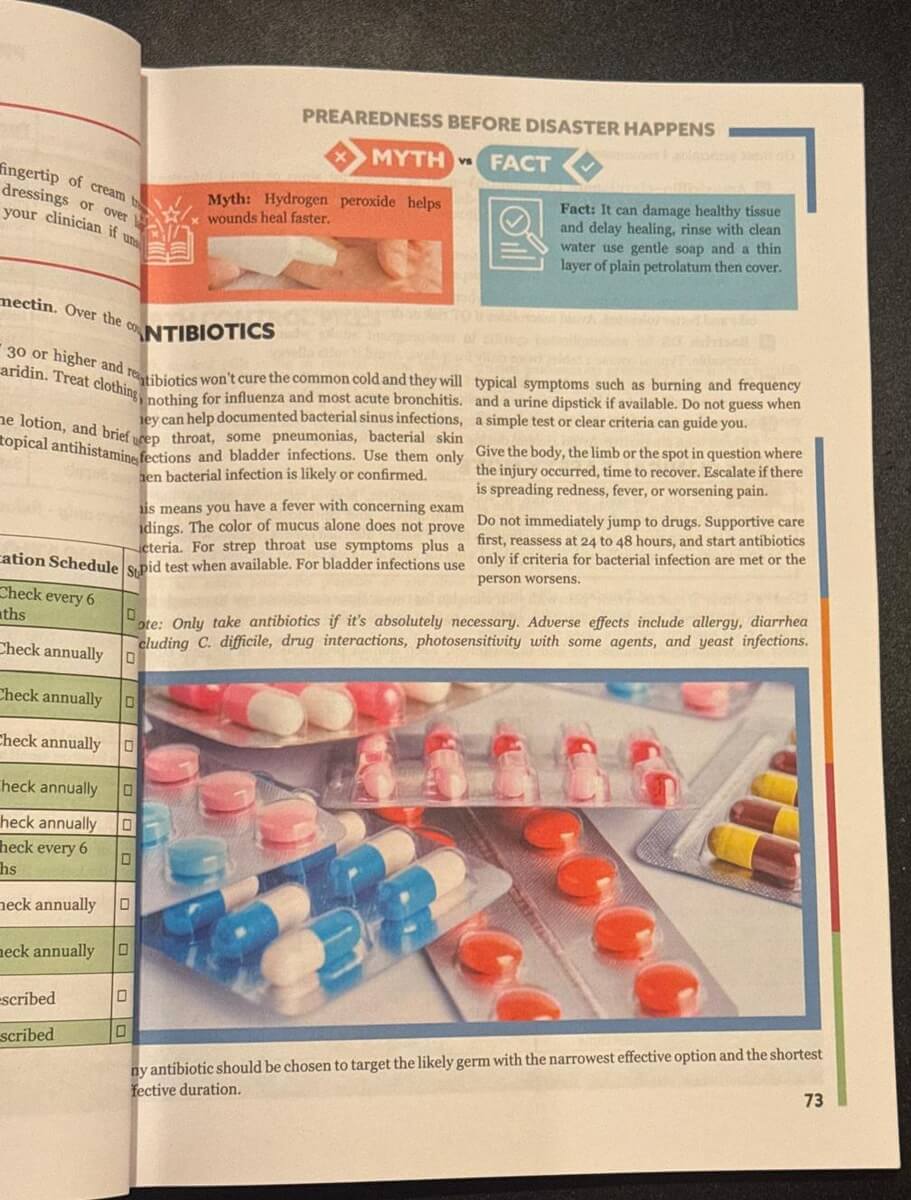
- Antibiotics belong in a home reserve only when a clinician has provided a written plan for specific conditions.
- Never use veterinary antibiotics for people.
- Supportive care first. Don't jump straight to drugs. Reassess, and use antibiotics only when a bacterial infection is likely or confirmed.
- Chronic-condition charts follow a strict "No Self-Tapering" rule: don't stop or change medication on your own.
Winner: Survival MD. It's built on the oldest rule in medicine: "first, do no harm."
5. Chronic Disease: Survival MD Goes Deeper Where It Matters Most
For many families, the biggest risk in a long emergency isn't an injury. It's a chronic condition that gets out of control when the pharmacy closes.
Survival MD dedicates a full chapter, Specific Disease Preparedness, to conditions by body system: nervous, respiratory, circulatory, digestive, urinary and metabolic, including diabetes, kidney stones and kidney failure. Each one comes with color-coded zones: what each stage means, the supplies to keep on hand and the actions to take.
The Handbook covers medical issues by body system too, but Off-Grid's fourth-edition review noted that its heart section lacks depth, and heart disease is one of the most common serious conditions in America.
If someone in your home takes daily medication for a heart, lung, digestive or metabolic condition, Survival MD's zone-by-zone plans give you something you can act on. More here: How Survival MD Handles Chronic Disease in a Crisis
Winner: Survival MD.
6. Natural Remedies: Quality and Safety Over Quantity
According to Off-Grid's review, the Handbook's natural medicine section covers 21 essential oils and 24 natural products, with recipes and applications.
That's a lot of material. But in a crisis, a long list of oils and recipes can tempt untrained people to treat serious problems at home that need real care, and some "natural" products can cause harm of their own.
Survival MD's Alternative Medicine chapter is focused and evidence-minded. It covers herbal options for the 14 most common problems people face in a crisis, from fever discomfort, pain and cough to sleep, nausea, skin issues and bites. Each one has safety flags and a clear "when to get help" line. And the book uses Myth vs. Fact boxes to debunk popular natural remedies, so you know what not to waste time on.
Winner: Survival MD. It tells you what helps, what doesn't and when to stop.
7. Supply Planning: Survival MD Is Built for Your Household
The Handbook plans broadly. Off-Grid's third-edition review describes kit coverage from a personal medic bag and IFAK all the way up to a field hospital. That's ambitious, but most families aren't building a field hospital.
Survival MD is built around your home, with exact quantities:
- A 147-item home medical inventory for 2 adults + 1 child for 30 days
- The Lifeline Kit, with core medications and integrated medical and hygiene modules
- Response packs for superficial wounds, sutures or staples, and complicated wounds and fractures
- Kit lists for a basic and comprehensive first aid kit, a bug-out bag and a bug-out vehicle
- A medication rotation system so nothing expires unnoticed
Winner: Survival MD. You know exactly what to buy, how much and where it goes.
8. Value: More for Your Money
For $37, Survival MD gives you:
- The full-color printed book: 288 pages, 19 chapters, 150+ topics
- 4 bonus guides: When There's No Doctor For Your Child, When There's No Pharmacy, Herbal First Aid For When There's No Doctor and When There's No Vet
- A 60-day refund: your money back within 5 business days, and you keep everything
Winner: Survival MD.
The Final Score
| Category | Winner |
|---|---|
| Usability under stress | ✅ Survival MD |
| Format and color | ✅ Survival MD |
| Decision tools | ✅ Survival MD |
| Sources | ✅ Survival MD |
| Medication safety | ✅ Survival MD |
| Chronic disease | ✅ Survival MD |
| Natural remedies | ✅ Survival MD |
| Household supply planning | ✅ Survival MD |
| Value | ✅ Survival MD |
The Survival Medicine Handbook has earned its place as a well-known title in the prepper world. But if you're choosing one book to protect your family when no doctor can be reached, Survival MD is the one we recommend: clearer, more visual, better sourced, safer with medications and built around a real household.
Frequently Asked Questions
Which is better, Survival MD or The Survival Medicine Handbook?
For most families, Survival MD. It's full color, easier to use under stress, backed by 350+ references, more cautious with medications and built around a real household supply plan.
What's the main difference between the two books?
The Handbook is a 670-page, mostly text-based reference. Survival MD is a 288-page, full-color guide with flowcharts, color-coded zones, Clinical Safety Notes and Myth vs. Fact boxes, designed to be used in the moment.
Which book is better for beginners?
Survival MD. Its full-color layout, flowcharts and color-coded action zones make it easier for non-medical readers to know what to do next.
Which book is better for chronic conditions?
Survival MD, with a full chapter on chronic disease by body system, color-coded zones and clear rules like "No Self-Tapering."
Does Survival MD recommend fish or veterinary antibiotics?
No. Survival MD says never to use veterinary antibiotics for people and that antibiotics belong in a home reserve only with a clinician's written plan.
How much does Survival MD cost?
$37 for the full-color printed book, with 4 bonus guides and a 60-day refund in which you keep everything.
The Bottom Line
The Survival Medicine Handbook is a long, detailed text reference. Survival MD is a guide built to be used: full color, flowcharts, color-coded zones, 350+ current references, a safety-first approach to medications and a 147-item plan for a real household. When someone you love needs help and no doctor can be reached, that's the book you'll want to open.