The Chapter That Sets Up Everything Else
Most first-aid books open with bandages. Survival MD by Dr. Radu Scurtu opens with a question:
Imagine a disaster has struck, and you walk into an empty hospital. Everything is there: scanners, operating rooms, cabinets full of medicine. You have access to all of it. What do you do?
For most people, the honest answer is: nothing useful. Equipment is worthless if you don't know what to do with it. That's the idea behind Chapter 1, "Why Prevention and Practice Make Sense" (pages 14–19), and its message fits in six words:
"Begin during calm, not during chaos."
Survival MD
This chapter is short, but it shapes how you'll read every page that follows. Here's what's inside, and why it's worth reading in full.
Part 1: "The Most Valuable Tool"
What is the most important tool in any emergency? It's not a tourniquet, a suture kit or a bottle of antibiotics.
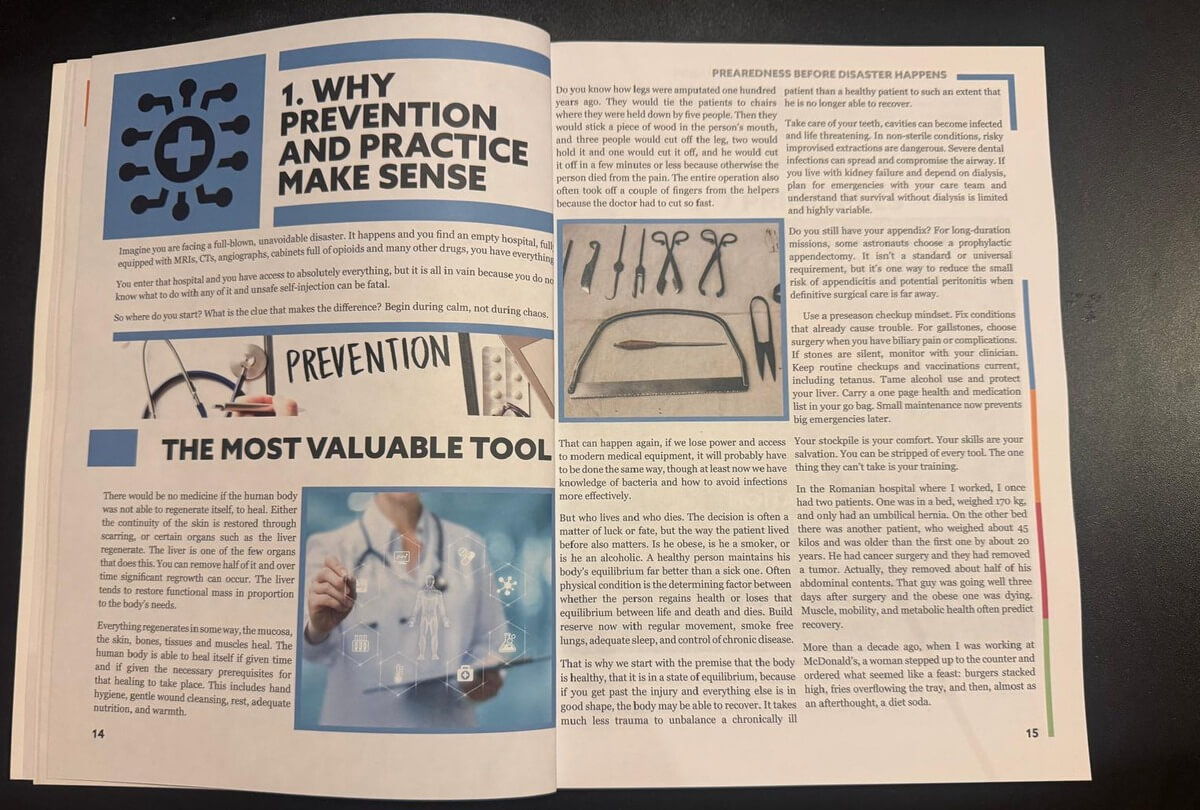
According to Dr. Scurtu, it's the human body's own ability to heal. Skin closes, bones knit, tissues repair, and some organs can even regrow. As the book puts it, "There would be no medicine if the human body was not able to regenerate itself."
But the body can only do that if it gets a few simple conditions. The chapter names them, and they're things almost anyone can provide, even without supplies. Knowing them changes how you think about every injury that follows in the book.
Part 2: Lessons From History and the Hospital Floor
Chapter 1 isn't a lecture. It's full of short, memorable stories that make the point stick:
- What surgery looked like a century ago, and why, without power and modern equipment, some of it could look the same again
- Two patients in the same hospital room, and why the one everyone expected to recover was the one in danger
- The astronaut rule: why some astronauts prepare for long missions in a way most people never would (we wrote about it here: What Is the "NASA Secret" in Survival MD?)
- A moment at a fast-food counter that changed how the author thinks about everyday habits and survival
Each story leads to the same conclusion, in the book's words: "You cannot control every outcome, but you can stack the odds overwhelmingly in your favor."
Part 3: The 7 Principles to Save a Life
This is the heart of the chapter, and arguably of the whole book.
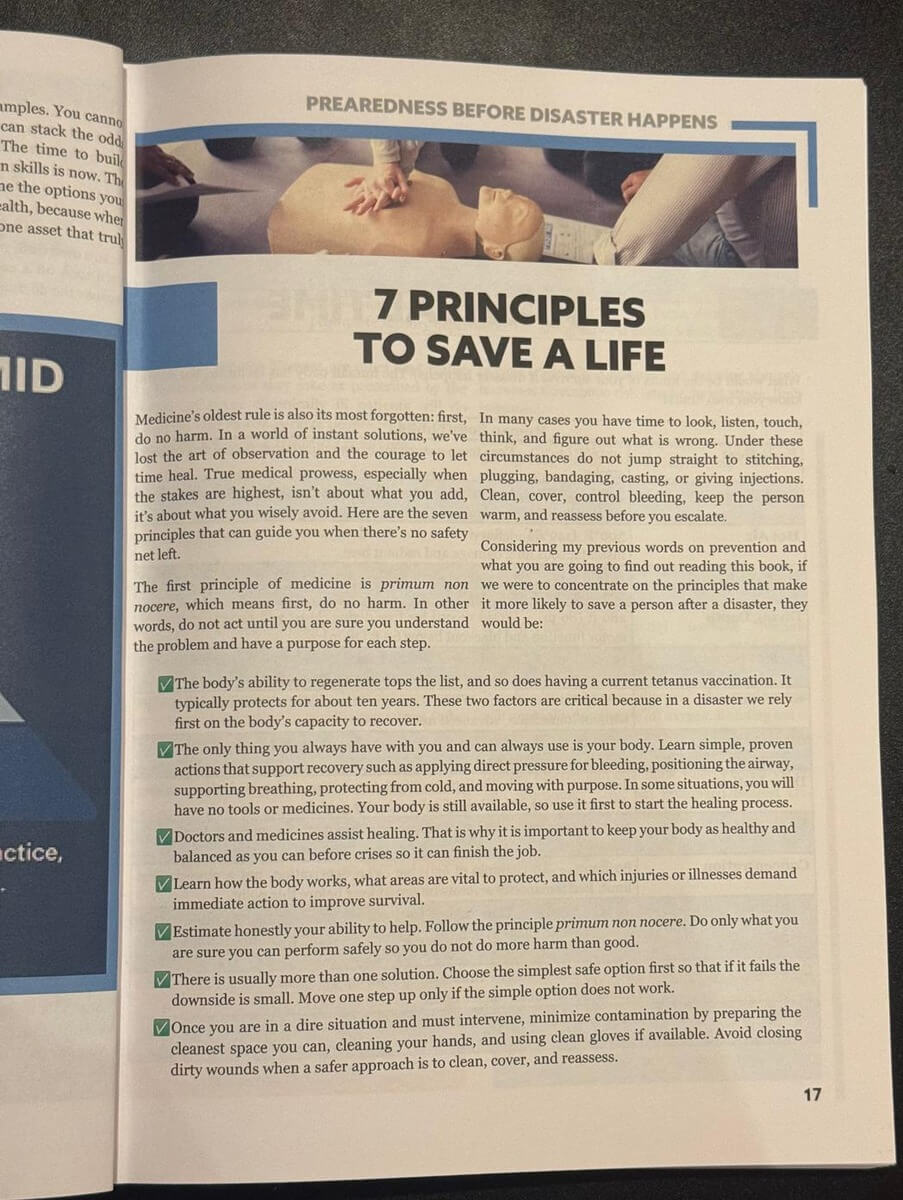
Dr. Scurtu sets out seven principles to guide you when there's no safety net left. The first is the oldest rule in medicine: primum non nocere, first, do no harm. Don't act until you understand the problem and have a purpose for each step.
Another one we love: there's usually more than one solution, so choose the simplest safe option first. If it fails, the downside is small, and you only move up a step if you need to.
The other five principles cover what to prioritize before a crisis, what your own body can do when you have no tools at all, how to be honest about your limits, and how to protect someone from making things worse while you help. Together, they're the mindset that runs through all 19 chapters.
Part 4: "Survival Time": Do You Know Your Body's Limits?
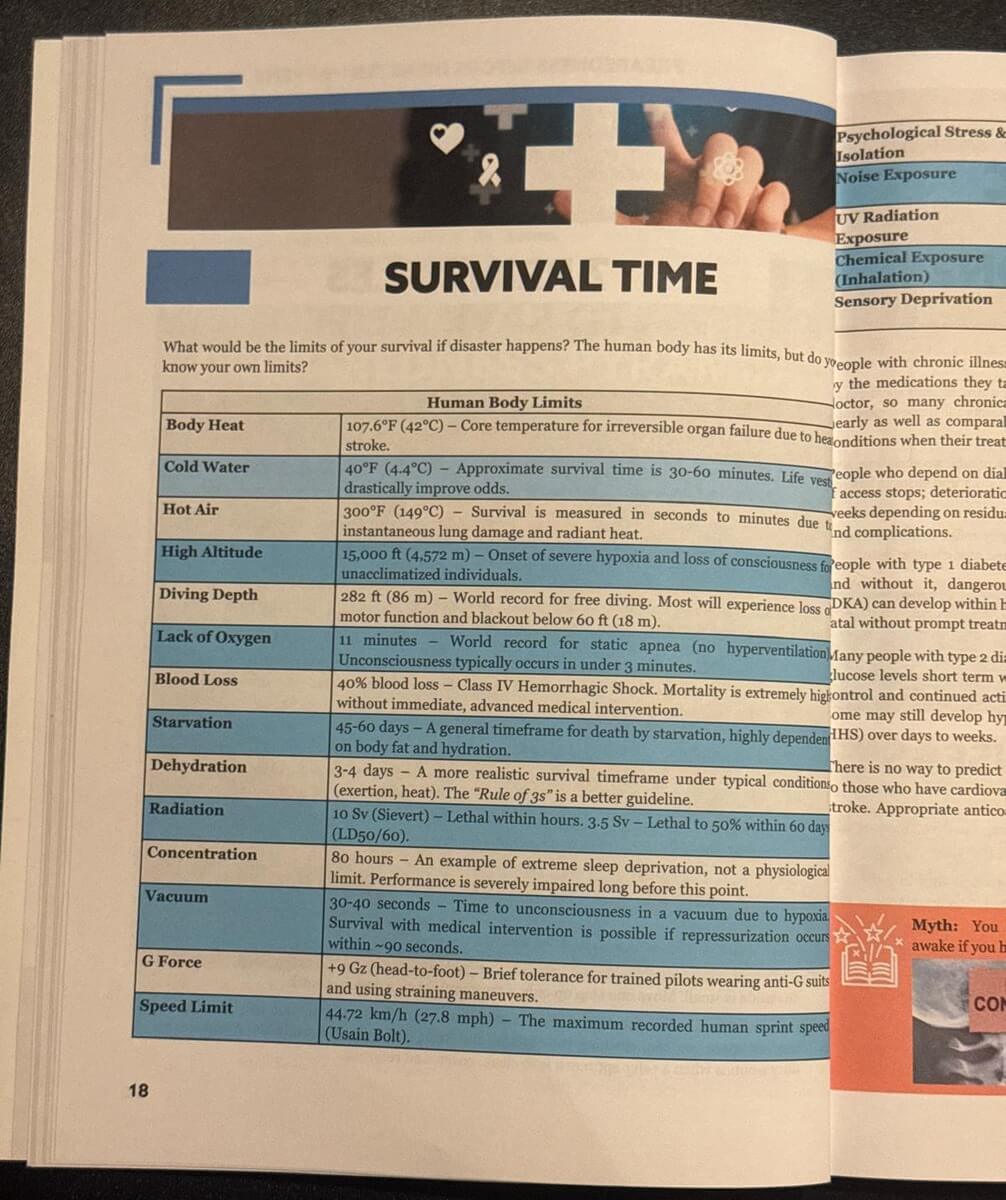
Next comes one of the most fascinating pages in the book: a Human Body Limits table with 19 entries, showing how long the human body can last, or how much it can take, under extreme conditions.
Two examples:
- Cold water: at 40°F (4.4°C), approximate survival time is just 30 to 60 minutes
- Lack of oxygen: unconsciousness typically occurs in under 3 minutes
The rest of the table covers limits for heat, blood loss, dehydration, starvation, smoke inhalation, radiation, extreme stress and more. Some of the numbers are surprising, and a few may change what you think matters most in an emergency.
Part 5: What Happens When Treatment Stops
The chapter then turns to something most preparedness books ignore: people with chronic illnesses.
Dr. Scurtu explains a reassuring truth, that many people with chronic conditions do almost as well as anyone else as long as their treatment continues. Then he explains what can happen, and how quickly, when it stops: for people on insulin, dialysis, oxygen, blood thinners and more.
This short section sets up the detailed "Specific Disease Preparedness" chapter that follows, with color-coded zones and medication supply plans. (More here: How Survival MD Handles Chronic Disease.)
Part 6: The First "Myth vs. Fact"
Chapter 1 closes with the first of the book's 70 "Myth vs. Fact" boxes. It takes on a piece of advice almost everyone has heard about head injuries, and explains why it's outdated and what to do instead.
It's a perfect preview of what's to come: throughout the book, Survival MD keeps correcting the common habits and old advice that can make an emergency worse.
Why Chapter 1 Matters So Much
It would have been easy for the book to jump straight into bleeding and broken bones. Instead, Chapter 1 does something more valuable: it changes how you think.
- Prevention beats reaction. The best emergency is the one you avoid or prepare for in advance.
- Skills beat stuff. As Dr. Scurtu puts it elsewhere in the chapter: "Your stockpile is your comfort. Your skills are your salvation."
- Do no harm. Knowing what not to do is just as important as knowing what to do.
- Start now. "The time to build resilience is now. The time to gain skills is now."
Read this chapter first, and every chapter after it makes more sense.
What Comes After Chapter 1
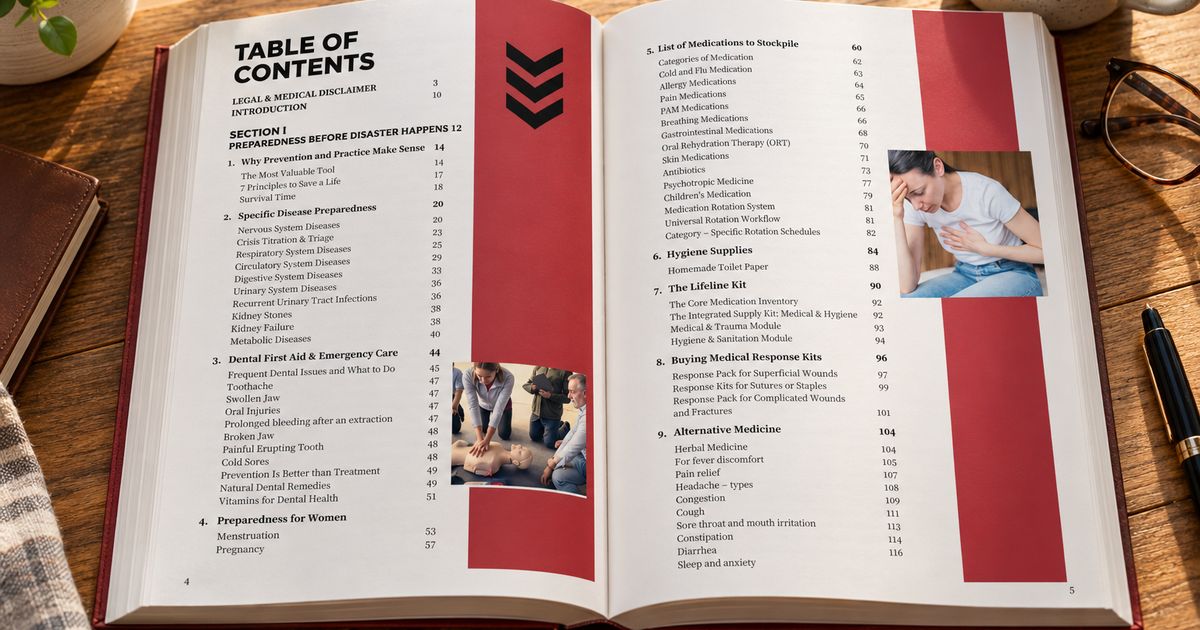
Chapter 1 is the foundation. The rest of Survival MD builds on it across 19 chapters, 280+ pages and 150+ topics:
- Specific disease preparedness for chronic conditions
- Dental first aid, women's health and children's medicine
- Medications to stockpile and how to rotate them
- First aid kits, the 147-item Master Inventory and emergency sanitation
- Assessment, triage and CPR for adults, children and babies
- Bleeding, wounds, burns, fractures and trauma
- Sudden illness, infections and how to manage without prescriptions
Frequently Asked Questions
What is Chapter 1 of Survival MD about?
Chapter 1, "Why Prevention and Practice Make Sense" (pp. 14–19), explains the mindset behind the whole book: the body's ability to heal, the 7 Principles to Save a Life, the limits of the human body, how chronic illness changes in a crisis, and the first Myth vs. Fact box.
What are the 7 Principles to Save a Life?
They're the guiding rules of the book, starting with "first, do no harm" and "choose the simplest safe option first." The full list, with the reasoning behind each principle, is in Chapter 1.
Is Chapter 1 just theory?
No. It's short and practical, built around real stories from the author's hospital experience, and it sets up the hands-on chapters that follow.
Do I need medical training to understand it?
No. Like the rest of the book, it's written in plain English for people without a medical background.
The Bottom Line
Chapter 1 is where Survival MD turns from a medical book into a way of thinking: prepare early, protect the body's ability to heal, know your limits and never make things worse. It's only a few pages, but you'll feel its influence on every page after it.
You've had a preview. The full chapter, and the 18 that follow, are waiting in the book.