The Astronaut Rule Hidden on Page 15
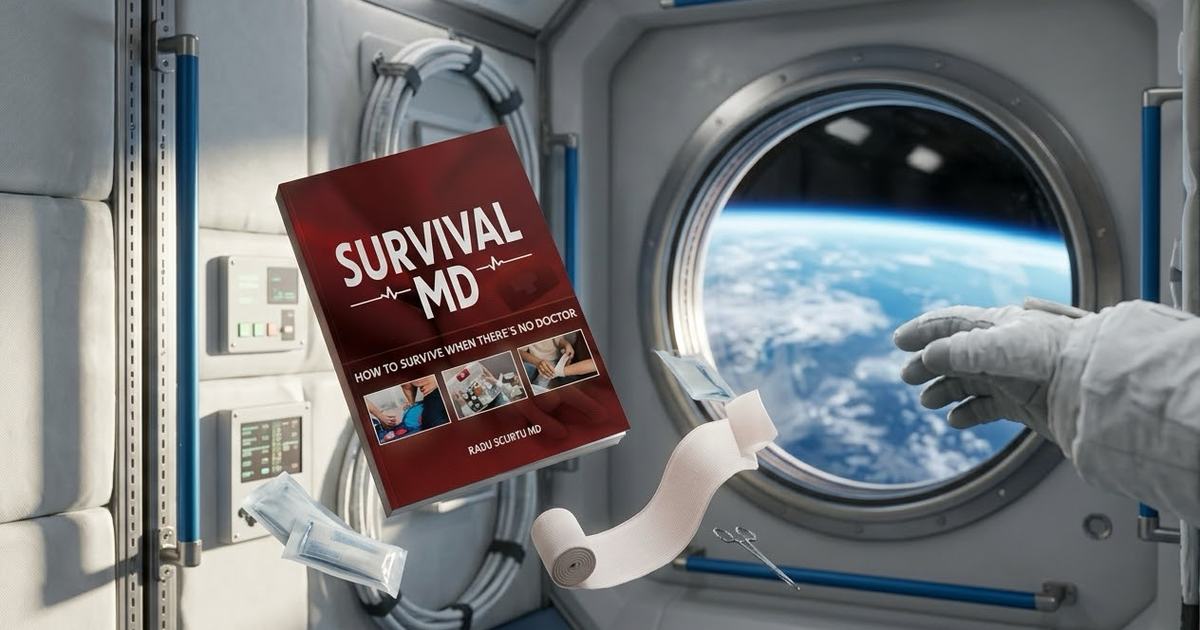
The "NASA secret" is the name readers have given to a short passage on page 15 of Survival MD by Dr. Radu Scurtu. It describes how some astronauts on long-duration missions choose to have their appendix removed before they leave.
Appendicitis is rare, but if it happens months away from the nearest surgeon, a small risk becomes a life-threatening one. So rather than hope it never happens, some astronauts remove the risk before they go.
Survival MD takes that same idea and applies it to ordinary families: deal with the problems you can predict before you're cut off from medical care. The book calls it a "preseason checkup mindset," and it shapes the whole first half of the book.
Why Would an Astronaut Remove a Healthy Appendix?
On Earth, appendicitis is a routine emergency. You feel the pain, you go to the hospital, a surgeon operates, and you go home a few days later.
In space, there's no hospital. There's no surgeon down the hall. If the appendix becomes inflamed and bursts, it can lead to peritonitis, a dangerous infection inside the abdomen, with no way to get proper surgical care in time.
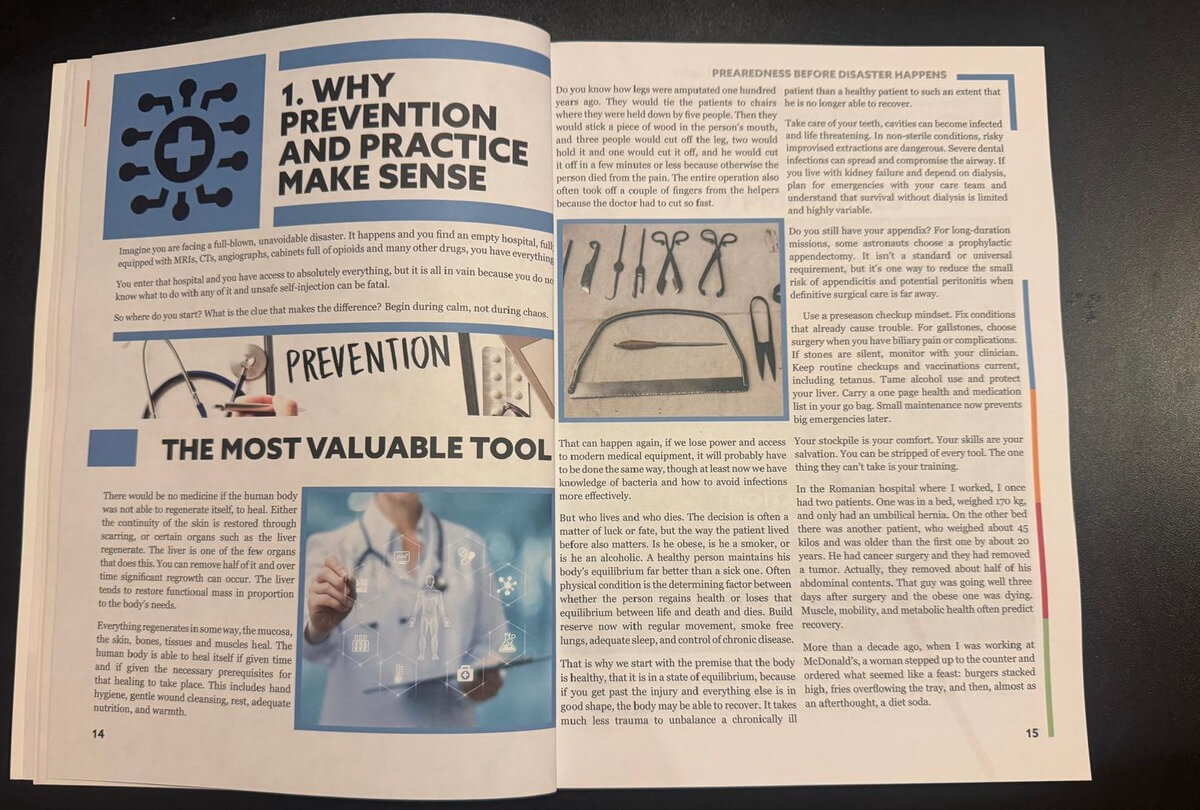
As the book puts it, a prophylactic appendectomy "isn't a standard or universal requirement, but it's one way to reduce the small risk of appendicitis and potential peritonitis when definitive surgical care is far away."
The point isn't the appendix. The point is the thinking behind it:
When help is far away, the smartest thing you can do happens before the emergency.
The Same Rule, Applied to Your Family
Most of us will never go to space. But plenty of situations put us "far from definitive care": a hurricane, a long blackout, a flooded road, a rural home an hour from the nearest ER, or a hospital so overwhelmed it can't take you.
Right after the astronaut example, Survival MD turns the idea into everyday advice. Here are some of the examples from that section:
1. Fix the problems that are already causing trouble
If a health issue is already flaring up now, it won't politely wait for a better time. The book gives gallstones as an example: if they're already causing pain or complications, that's the time to deal with them, while care is available. Silent ones can simply be monitored with your doctor.
2. Keep your vaccinations current, especially tetanus
The book lists an up-to-date tetanus shot as one of the most important things you can have going into a disaster. It typically protects for about ten years, and in a crisis, dirty wounds are everywhere.
3. Don't ignore your teeth
This one surprises people. Survival MD warns that a cavity can become infected and turn life-threatening when no dentist is available, and that severe dental infections can spread far enough to threaten the airway. Fixing a bad tooth now is the "appendix removal" most families actually need.
4. Carry a one-page health and medication list
A single sheet in your go-bag with your conditions and medications. If you're hurt and can't speak for yourself, whoever helps you will know what they're dealing with.
5. Build a buffer of your prescriptions
The book recommends keeping at least a two-week supply of every regular prescription, and working toward 30 days or more when your doctor and insurer allow it, with a rotation system so nothing expires.
6. Build your body's reserve
This is the part that stayed with us. Dr. Scurtu describes two patients from a Romanian hospital where he worked: one was obese and in for a simple hernia, the other was older and thin after major cancer surgery. Three days later, the cancer patient was doing well and the hernia patient was dying.
His conclusion: muscle, mobility and metabolic health often predict who recovers. Regular movement, smoke-free lungs, good sleep and well-controlled chronic conditions are all preparation you can start today.
"Your stockpile is your comfort. Your skills are your salvation. You can be stripped of every tool. The one thing they can't take is your training."
Survival MD, p. 15
There's Much More Where That Came From
The astronaut passage is only a few lines on a single page, and it opens one of the most valuable parts of the book. Here's a taste of what follows. You'll find the full details inside.
A color-coded plan for chronic conditions
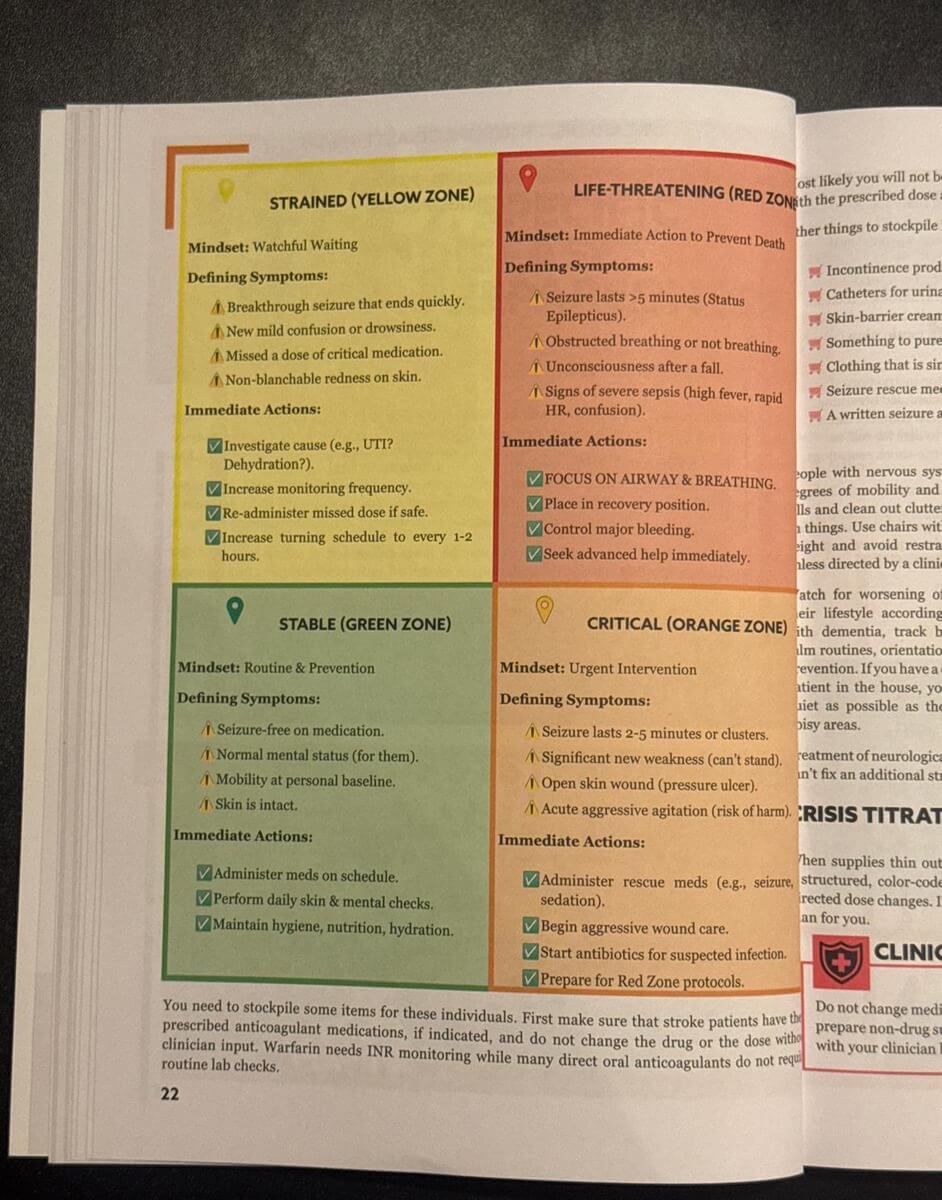
For conditions like stroke, seizure disorders, heart disease, lung disease and diabetes, the book uses a four-zone system: Green (stable), Yellow (strained), Orange (critical) and Red (life-threatening). Each zone has its own mindset, warning signs and immediate actions, so you know when to watch, when to act and when every minute counts. We cover it in detail in how Survival MD handles chronic disease in a crisis.
What really happens when medication runs out
Survival MD explains, condition by condition, how quickly people can get into trouble without their usual medication, from insulin and oxygen to blood thinners and dialysis. It also covers what you can do in advance to protect them.
The emergencies other books forget
Dental first aid, women's health and pregnancy, children's medicine and medications to stockpile, all in the "before disaster" half of the book, built on the same idea: prepare while you still can.
And then the "after" half
Assessment, triage, CPR, shock, bleeding, burns, fractures, infections and sudden illness, step by step, for the moment the emergency actually arrives.
Why This Matters More Than Any Single Tip
Most first-aid advice is about reacting. The "NASA secret" is about preventing the emergency you can see coming. That's what makes Survival MD different from a basic first-aid booklet: it doesn't just help you respond when something goes wrong, it helps you remove problems before they ever turn into emergencies.
It's the same reason astronauts prepare months before launch. And it's why the book is built for situations where you can't reach a doctor at all.
Frequently Asked Questions
What is the "NASA secret" in Survival MD?
It's a passage on page 15 describing how some astronauts on long-duration missions choose to have their appendix removed beforehand, because appendicitis far from a surgeon can become life-threatening. The book uses it to explain a "preseason checkup mindset": fix predictable health problems before you lose access to medical care.
Does the book use the phrase "NASA secret"?
No. The book talks about astronauts on long-duration missions. "NASA secret" is the nickname readers use for the passage.
Do all astronauts have their appendix removed?
No. Survival MD itself notes that it "isn't a standard or universal requirement," just one way some astronauts reduce the risk when surgical care is far away.
Is Survival MD telling me to remove my appendix?
No. The appendix is just an example of the principle. For families, the book focuses on practical steps such as treating problems that are already flaring up, keeping vaccinations current, dental care, a medication list and a prescription buffer. Always make medical decisions with your own doctor.
Where can I read the full section?
In Survival MD by Dr. Radu Scurtu. The astronaut passage is on page 15, and the disease preparedness chapter that builds on it starts on page 20.
The Bottom Line
The "NASA secret" isn't a trick. It's a way of thinking: when help might be far away, prepare before you need it. Survival MD turns that idea into a complete plan for your family, from your teeth and your medications to the moment someone gets hurt.
You've just read a few lines from page 15. The other 280+ pages are where the real preparation happens. For a look at the whole book, read our complete Survival MD review.