The Minutes That Decide Everything
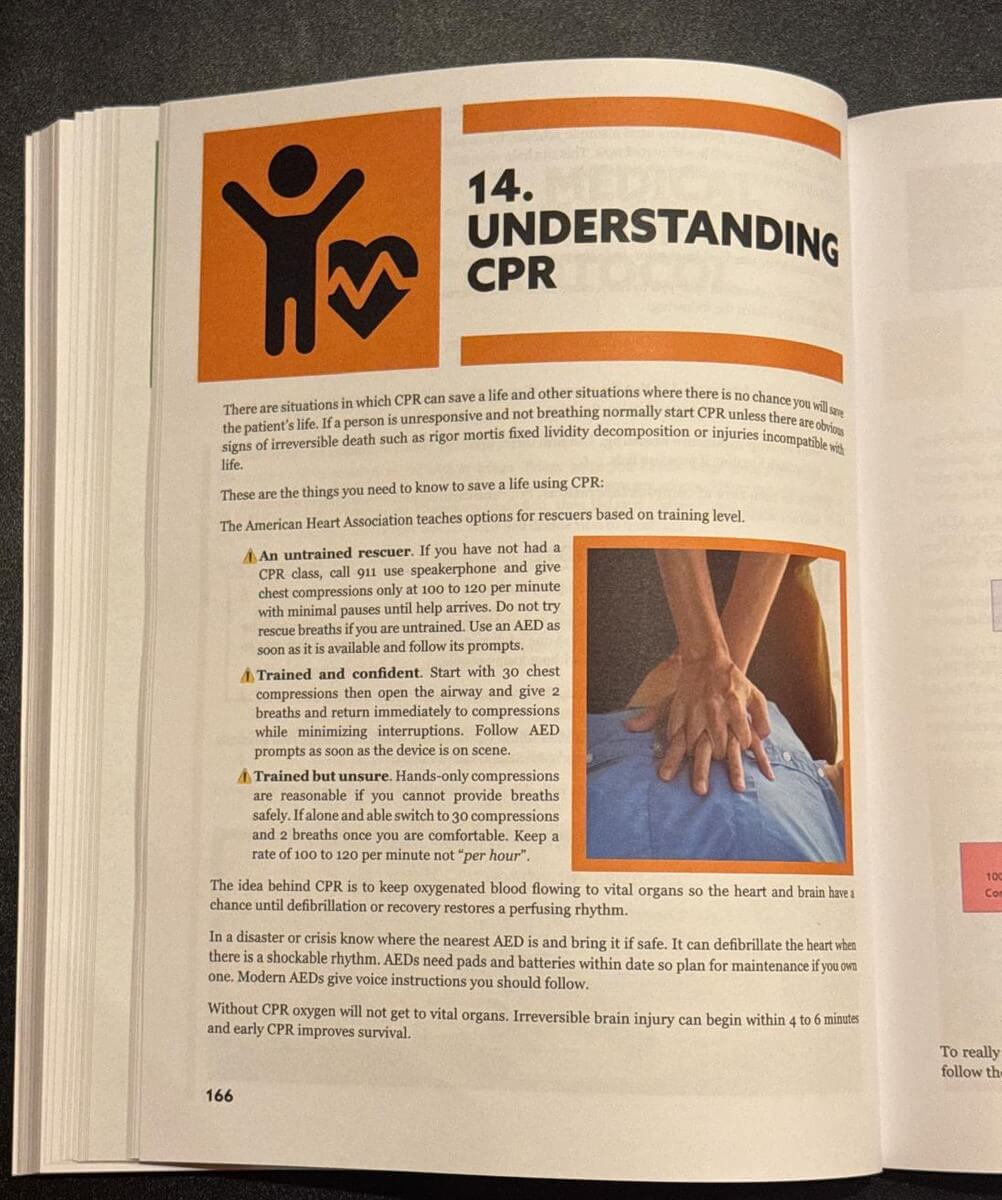
If someone collapses and stops breathing normally, the clock starts immediately. As Chapter 14 of Survival MD reminds readers: "Without CPR oxygen will not get to vital organs. Irreversible brain injury can begin within 4 to 6 minutes and early CPR improves survival."
In a normal emergency, an ambulance may arrive within those minutes. In a disaster, it may not come at all. That's when knowing what to do with your own two hands matters most.
Chapter 14, "Understanding CPR" (pages 166–182), is one of the most important chapters in the book. It covers CPR for adults, children and babies, the use of an AED, how to recognize and respond to shock, and how to help someone who is choking, all with clear steps and visual flowcharts.
CPR for Every Level of Training
One thing we really like about this chapter: it doesn't assume you're a paramedic. Following American Heart Association guidance, it explains what to do based on your level of training:
- If you're untrained: call 911 on speakerphone and give hands-only chest compressions at 100 to 120 per minute until help arrives. Use an AED as soon as one is available.
- If you're trained and confident: the book explains the full cycle of compressions and rescue breaths.
- If you're trained but unsure: the book explains when hands-only compressions are a reasonable choice, and when to switch.
That means anyone in the family can use this chapter, whether or not they've ever taken a class. (The book also recommends taking an accredited CPR class, and so do we.)
The chapter opens with a CPR Decision Flowchart to guide you from the moment someone collapses.
Part 1: Quickly Assess the Patient
Before compressions comes a quick assessment, and this section shows you how to do it in seconds. It also includes a piece of advice that can make a real difference in a crowd:
Don't just shout "Call 911!" Point to one specific person and ask them to call. The book explains the bystander effect: the more people who are present, the less likely anyone is to act, because everyone assumes someone else will.
It also explains why someone has to take the lead and assign tasks, one person at a time.
Part 2: From ABC to CAB
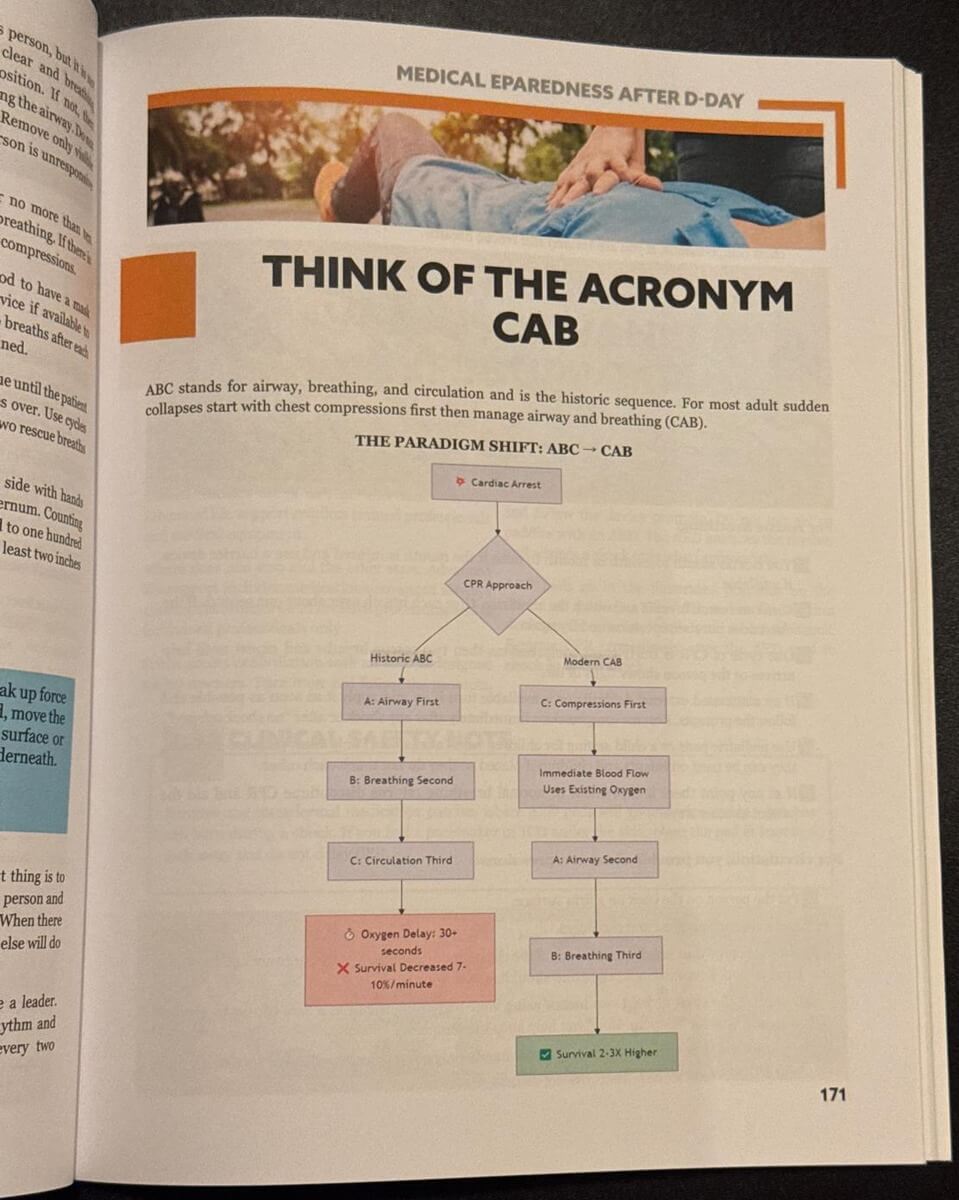
Many people learned CPR as ABC: airway, breathing, circulation. Survival MD explains why, for most adults who suddenly collapse, the order is now CAB: compressions first, then airway and breathing.
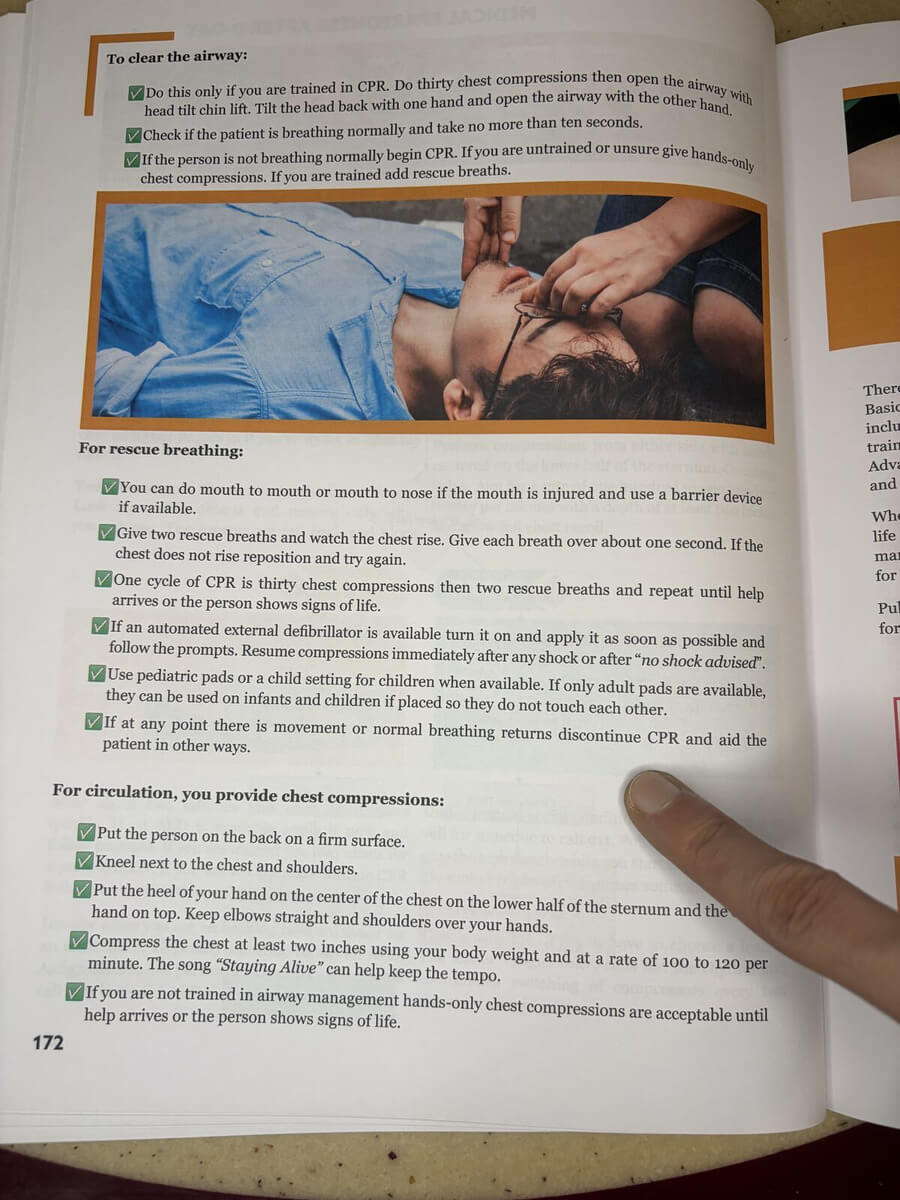
The chapter includes a visual chart, "The Paradigm Shift: ABC → CAB," that shows the difference side by side, and step-by-step instructions for each part: how to open the airway, how to give rescue breaths if you're trained, and how to give effective chest compressions, including hand position, depth and rate.
One tip we'll share from the book: the song "Stayin' Alive" has the right tempo for compressions.
Part 3: Basic vs. Advanced Life Support, and the AED
This section draws a clear line between what everyone should know (basic life support: compressions, rescue breaths for trained rescuers, using an AED) and what's for trained professionals only (advanced life support).
It also explains, in plain language, what an AED actually does, and why it only advises a shock when the heart's rhythm calls for one. There's a BLS vs ALS chart to make the difference easy to see.
And a Clinical Safety Note we'll share, because almost nobody knows it:
- Remove any medication patches where the AED pads will go and wipe off the residue. Patches can burn during a shock.
- If you feel a pacemaker or implanted defibrillator under the skin, place the pad at least one inch away, and don't delay CPR.
Part 4: Recognizing Shock
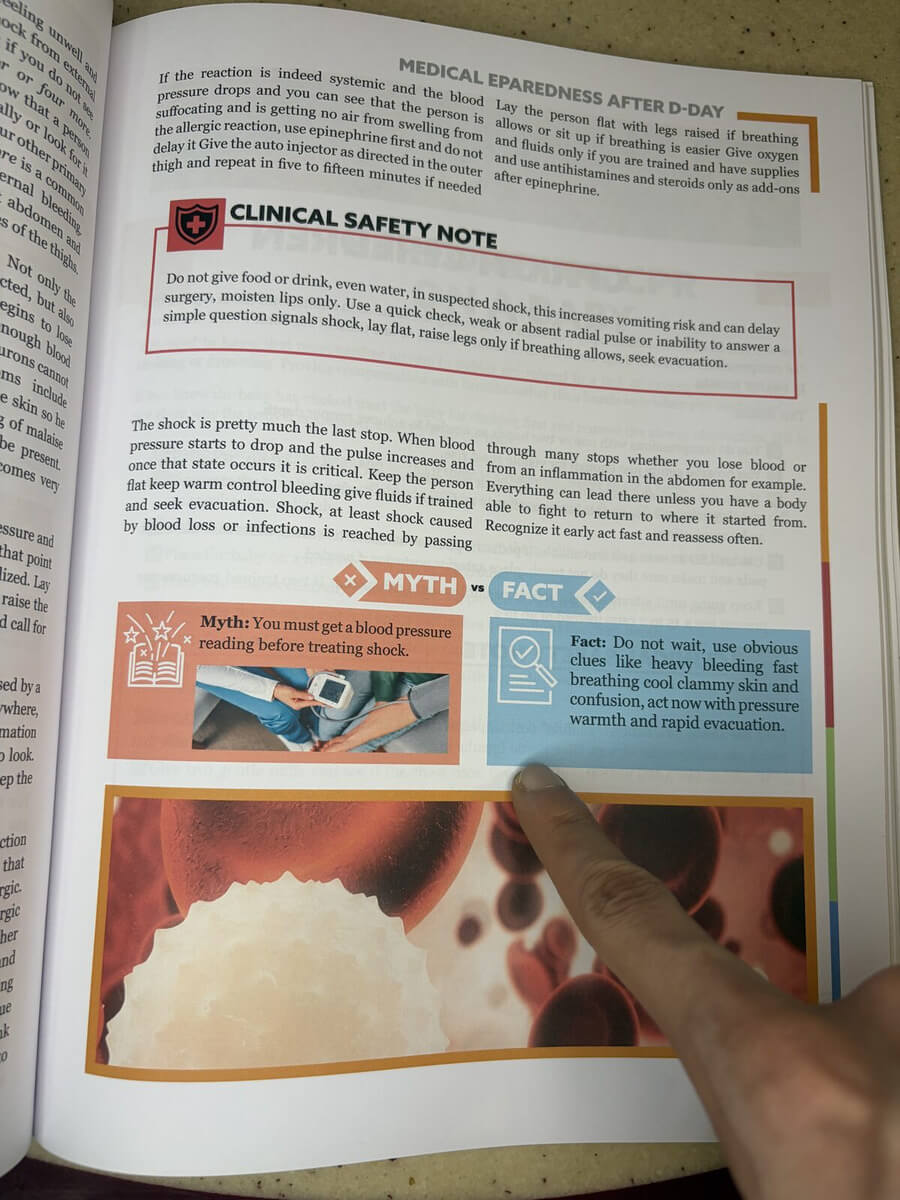
Shock is one of the most dangerous conditions in any emergency, and one of the easiest to miss. This section explains what shock is, using the example of a severe allergic reaction and blood loss, in a way anyone can understand.
It covers:
- The warning signs of shock, and a quick check you can do without equipment
- A memorable phrase doctors use to find hidden bleeding: "blood on the floor or four more", and what the four other places are
- What to do, and what not to do, while you wait for help
- A Shock flowchart that shows how the body collapses, step by step
There's also a Myth vs. Fact box that corrects a common, and deadly, assumption about when to start treating shock. The answer is in the book.
Part 5: CPR on Children and Babies
Children aren't small adults, and babies are different again. Survival MD gives each one its own section:
- CPR on children (ages 1 to 8): what changes in the depth, the hand technique and the breaths, and what to do if you're alone without a phone
- CPR on a baby: why most cardiac arrests in babies are caused by a lack of oxygen, how to check for a response safely (and why you should never shake a baby), finger placement, depth and gentle breaths
A Clinical Safety Note explains how to position a child's or baby's head so you don't accidentally close the airway, and why big breaths can make things worse.
The section ends with a Pediatric CPR Decision Flowchart.
Part 6: Choking Relief
The chapter closes with what to do when someone is choking, for adults, children and infants, and when the person is pregnant or very large.
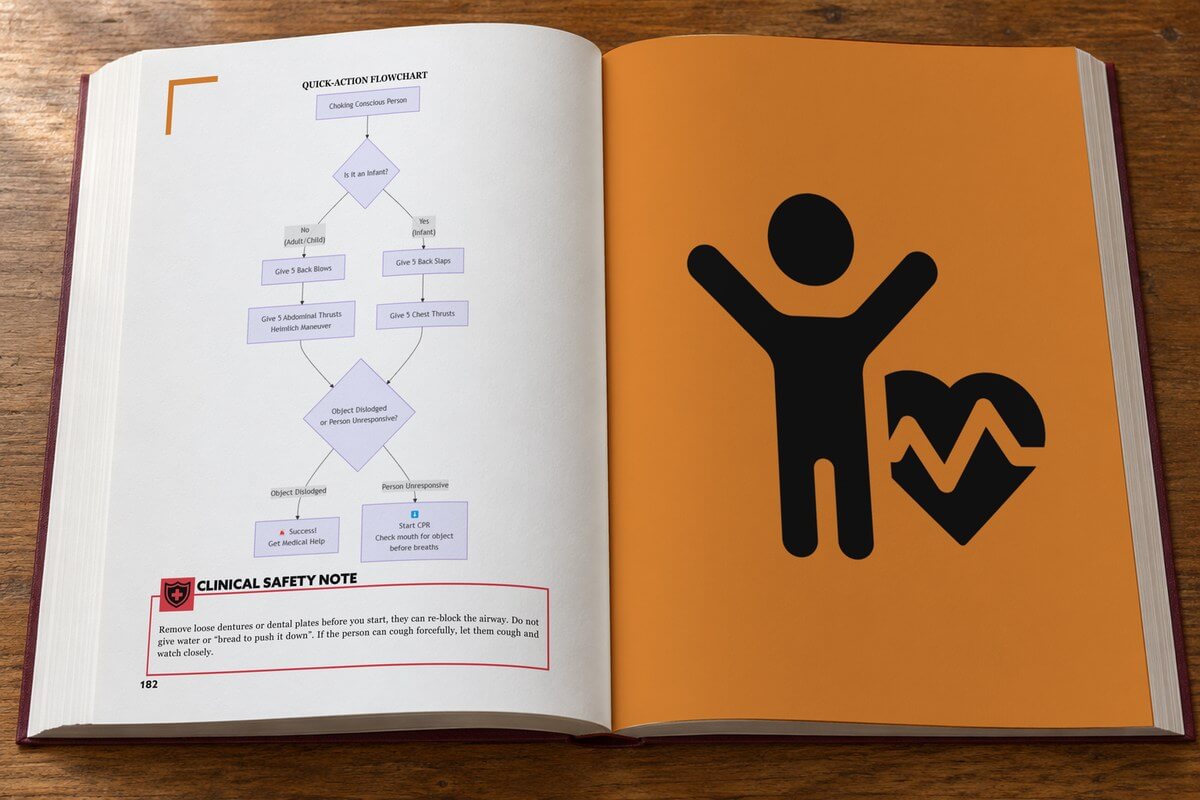
It explains how abdominal thrusts actually work (using the air that's always left in the lungs), the right hand position, the method for infants (who should never get abdominal thrusts), and what to do if the person becomes unresponsive.
There's a Quick-Action Flowchart to follow step by step, plus a Clinical Safety Note with three mistakes to avoid, including a "remedy" some people still try: don't give water or bread "to push it down."
Why Chapter 14 Matters
- It covers every age. Adults, children and babies, each with its own steps.
- It meets you where you are. Clear instructions for untrained, trained and unsure rescuers.
- It's visual. Flowcharts for CPR, CAB, life support, shock, pediatric CPR and choking.
- It goes beyond CPR. Shock and choking are covered too, two emergencies where minutes count.
- It's safety-first. Clear limits on what lay rescuers should and shouldn't attempt.
If there's one chapter every adult in your household should read, this is it.
What Comes After Chapter 14
Next comes Chapter 15, Common Illnesses in a Crisis: how people get hurt during disasters, the top five causes of injury, new wounds versus old wounds, how to stop bleeding, how to clean an injury, how to close a wound and how to keep it from getting infected.
Frequently Asked Questions
What is Chapter 14 of Survival MD about?
Chapter 14, "Understanding CPR" (pp. 166–182), covers assessing a patient, adult CPR, the CAB sequence, basic vs. advanced life support and AED use, shock, CPR on children and babies, and choking relief.
What should I do if I'm not trained in CPR?
Survival MD, following American Heart Association guidance, says to call 911 on speakerphone and give hands-only chest compressions at 100 to 120 per minute until help arrives, and to use an AED as soon as one is available.
Why is CPR now CAB instead of ABC?
For most adults who suddenly collapse, starting with chest compressions gets oxygen-carrying blood moving right away. The book explains the change with a side-by-side chart.
Does Survival MD cover CPR for babies?
Yes. It has dedicated sections for children aged 1 to 8 and for babies, plus a Pediatric CPR Decision Flowchart.
Should you give water to someone who is choking?
No. Survival MD warns against giving water or bread "to push it down." If the person can cough forcefully, let them cough and watch closely.
The Bottom Line
Chapter 14 is the chapter you hope you'll never need, and the one you'll be most grateful to have read. It turns CPR, shock and choking from frightening unknowns into clear, step-by-step actions for every age, whether or not you've ever taken a class.
You've had a preview. The full steps, safety notes and flowcharts are in the book.
Medical disclaimer: this article is for general information only and isn't medical advice. It's not a substitute for a certified CPR and first aid course. In an emergency, call 911 or your local emergency number.