When You're the Only One Standing
Chapter 13 of Survival MD opens with a scenario that's hard to read, and important to think through before it ever happens:
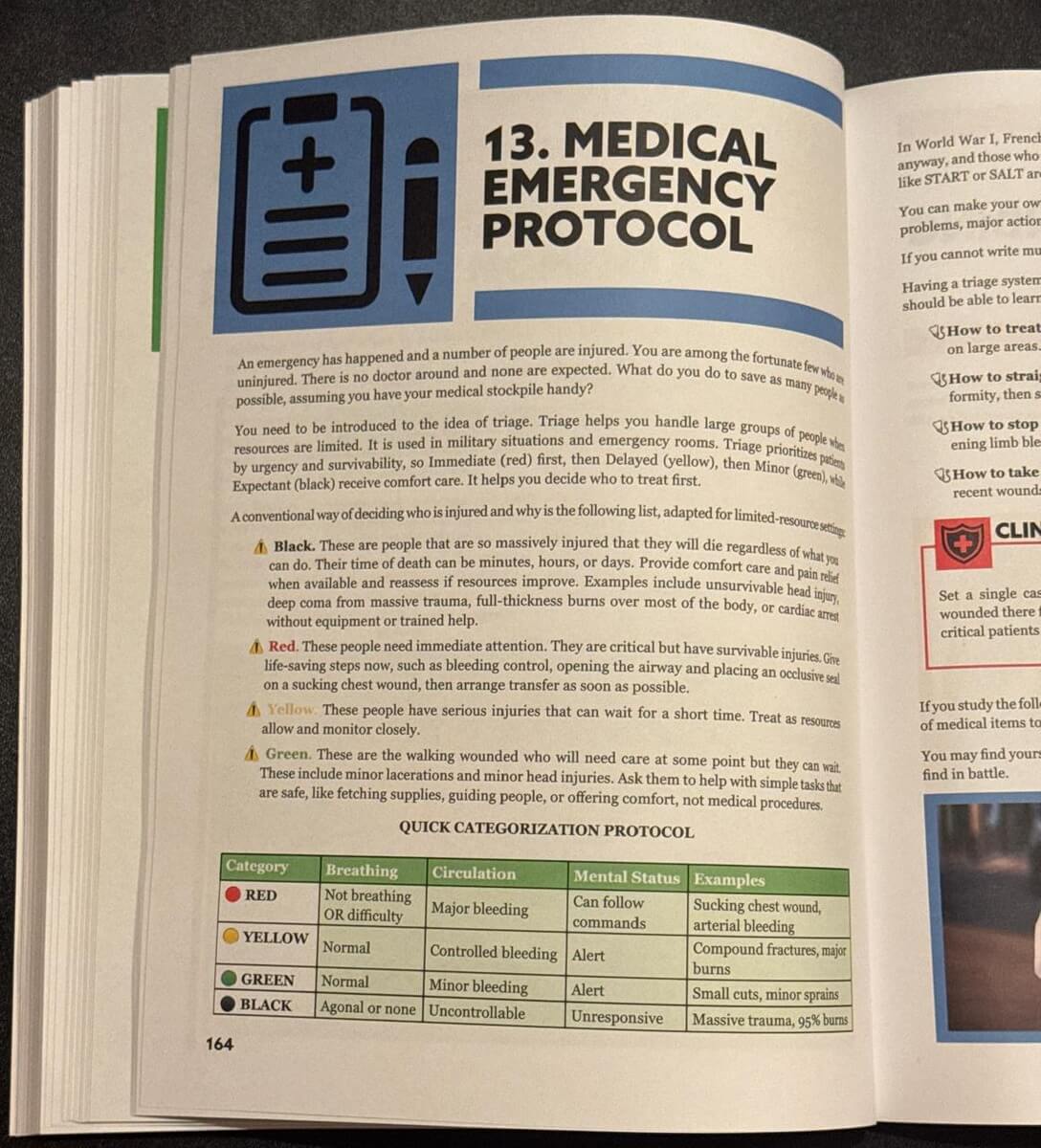
"An emergency has happened and a number of people are injured. You are among the fortunate few who are uninjured. There is no doctor around and none are expected. What do you do to save as many people as possible, assuming you have your medical stockpile handy?"
A collapsed building. A multi-car crash on a rural road. A tornado that tears through a neighborhood. In the first minutes, the people on the scene are the only medical help there is.
Chapter 13, "Medical Emergency Protocol" (pages 164–165), gives you the system emergency teams use in exactly these moments: triage. It's one of the shortest chapters in the book, just two pages, but it may be one of the most important to read before you need it.
What Triage Is, and Why It Matters
Triage is how military medics and emergency rooms handle more patients than they have hands for. As the book explains, it "helps you handle large groups of people when resources are limited" by sorting people by how urgent their injuries are and how likely they are to survive.
Without a system, people instinctively rush to whoever is screaming the loudest, or to the person they love most. That's human, but it can mean someone with a quiet, life-threatening injury gets missed. Triage replaces panic with a plan.
Chapter 12 introduced the emotional side of this decision in its "Moment X" section. Chapter 13 gives you the practical protocol to carry it out.
The Four Colors
Survival MD uses a classic four-color system, adapted for situations where resources are limited:
| Color | What it means |
|---|---|
| 🔴 Red | Critical but survivable. Needs help now. |
| 🟡 Yellow | Serious, but can wait a short time with close monitoring. |
| 🟢 Green | The "walking wounded." Will need care, but can wait. |
| ⚫ Black | Injuries so severe that survival isn't possible with the help available. Comfort care. |
For each color, the book explains what kinds of injuries belong there, with concrete examples, and what to do for that group: the life-saving steps for red patients, how to monitor yellow ones, and even how the walking wounded can safely help you, without doing anything medical.
It's not an easy topic, and the book handles the black category with care and dignity: comfort, pain relief when available and reassessment if more help arrives.
The Quick Categorization Protocol
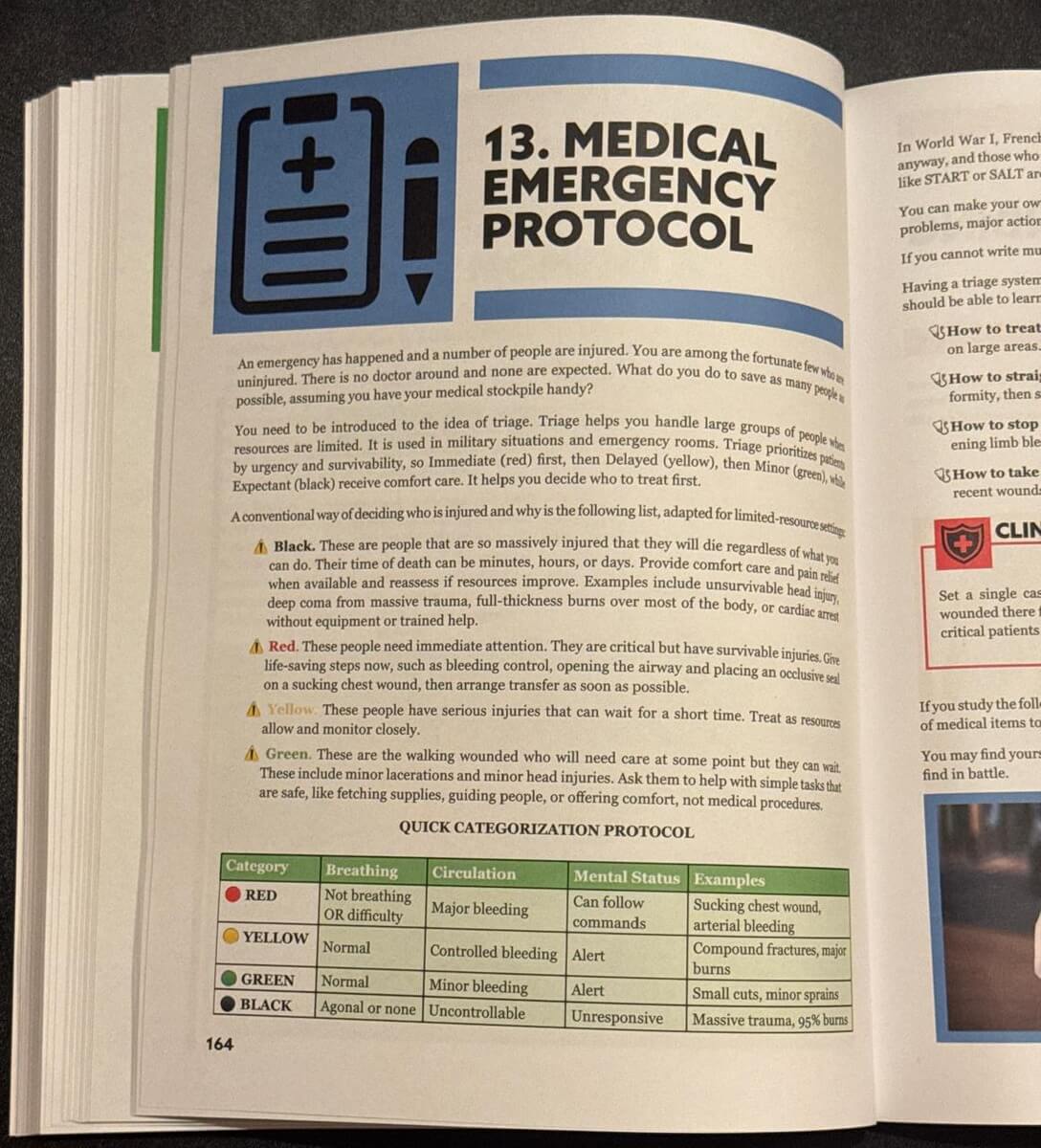
To make the sorting fast, Chapter 13 includes a Quick Categorization Protocol table. For each color, it shows what to look for in three areas:
- Breathing
- Circulation
- Mental status
Plus examples of typical injuries in each category. With it, you can sort a person in seconds by checking a few simple signs, without any medical equipment.
A Lesson From World War I
The chapter includes a short piece of history that makes triage easy to remember: a simple three-way scheme used by French physicians in World War I. It's a powerful way to frame your thinking in a crisis, and the book explains why modern field triage methods are preferred whenever possible.
Setting Up a Casualty Collection Point
Here's a Clinical Safety Note from the chapter we'll share, because it's simple and it works:
- Set up one casualty collection point, upwind and uphill from hazards.
- Send the walking wounded there first to clear the scene fast.
- Put one adult in charge of recording names and times at that spot, so critical patients and actions can be tracked without losing anyone.
The Four Skills Every Layperson Should Learn
Chapter 13 ends by pointing you toward what comes next. Once you understand triage, the book says, you'll want to learn how to treat the most common serious injuries. It names four skills every non-medical person should be able to learn:
- Treating mild to moderate burns
- Splinting fractures
- Stopping moderate bleeding
- Caring for complex lacerations
Each one comes with a short, safety-first summary in the chapter, and the following chapters of Survival MD teach them in full detail.
Why Chapter 13 Matters
- It replaces panic with a plan. A clear system for deciding who to help first.
- It's fast. The color system and categorization table let you sort people in seconds.
- It keeps people from getting lost. Simple tags and a single collection point.
- It's realistic. Built for limited resources and no doctor on the way.
- It points you forward. The four skills to learn next, covered in the chapters that follow.
What Comes After Chapter 13
Next is Chapter 14, Understanding CPR: how to quickly assess a patient, the CAB sequence and CPR for adults, children and babies. After that, Survival MD covers common illnesses in a crisis, and the full chapters on bleeding, wounds, burns and fractures.
Frequently Asked Questions
What is Chapter 13 of Survival MD about?
Chapter 13, "Medical Emergency Protocol" (pp. 164–165), explains how to use triage to help as many people as possible when several are injured and no doctor is available, with a four-color system, a Quick Categorization Protocol, homemade triage tags and a casualty collection point.
What are the triage colors in Survival MD?
Red (critical but survivable, treat now), yellow (serious but can wait briefly), green (walking wounded) and black (not survivable with the help available, comfort care).
How do you decide a person's triage category?
Survival MD's Quick Categorization Protocol checks breathing, circulation and mental status, with examples for each color. The full table is in the book.
Where should you set up a casualty collection point?
According to Survival MD, upwind and uphill from hazards, with one adult recording names and times.
What's the difference between Chapter 12 and Chapter 13?
Chapter 12's "Moment X" covers the emotional decision of who to help first. Chapter 13 gives the practical protocol: the color categories, the categorization table, tags and a collection point.
The Bottom Line
Chapter 13 is short, but it gives you something priceless in a mass-injury emergency: a way to think clearly when everyone needs help at once. Four colors, a quick table, simple tags and one collection point can turn chaos into a plan, and save lives.
You've had a preview. The full protocol, categorization table and tagging method are in the book.
Medical disclaimer: this article is for general information only and isn't medical advice. Formal first aid and triage training is strongly recommended. In an emergency, call 911 or your local emergency number.