What "Working" Means for a Medical Book
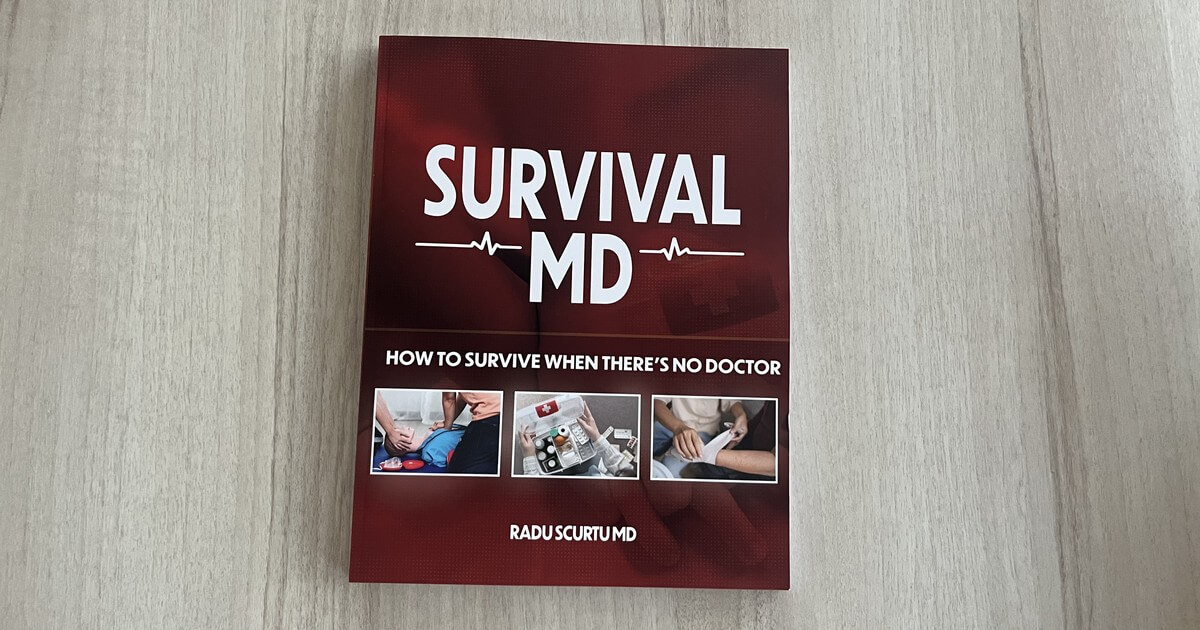
A pill works if it treats something. A gadget works if it switches on. But what does it mean for a book to "work"?
For an emergency guide like Survival MD by Dr. Radu Scurtu, it comes down to three things:
- You find the answer fast. In an emergency you have seconds, not minutes, to locate the right page.
- You understand the steps without medical training. No jargon, no guesswork, no wall of text.
- You know when to stop. A good guide tells you what you can safely do, what you must not do, and when a situation has gone beyond home care.
A book that fails any of these three fails you when it matters. So instead of telling you Survival MD is great, we'll show you how it handles three situations families actually face, and judge it on exactly those three points.
Our verdict up front: yes, it works. Here's why.
Situation 1: A Deep Cut That Won't Stop Bleeding
Picture itSomeone in your kitchen slips with a knife. There's a lot of blood, it's not slowing down, and everyone is looking at you.
Can you find the answer fast?
Yes. "How to Stop Bleeding" is its own chapter heading in huge letters (p. 188), and the injury section of the book is laid out around exactly these moments. The index at the back also lists bleeding, wounds and tourniquets with page numbers, so you're not flipping through 280 pages hoping to get lucky.
Can you understand the steps without training?
Yes. The section starts by teaching you to recognize what kind of bleeding you're dealing with, because that changes what you do. The steps are short and in order, and a Clinical Safety Note highlights the one mistake almost everyone makes under stress. A Myth vs. Fact box also stops a classic instinct: grabbing a belt as a tourniquet. Most belts are too narrow or stretchy to work and can damage tissue.
Does it tell you when to stop?
Yes, and this is where Survival MD shines. It's clear about which techniques should only be used if you're trained, why you shouldn't rush to close a deep or dirty wound, and which signs mean the person needs urgent care immediately. It also points you to the shock section, because heavy bleeding and shock often go together.
Score: 3 out of 3The full sequence of steps is in the book.
Situation 2: Someone Collapses and Isn't Responding
Picture itA family member suddenly collapses in the living room. They're not answering you. Your heart is pounding and you can't think straight.
Can you find the answer fast?
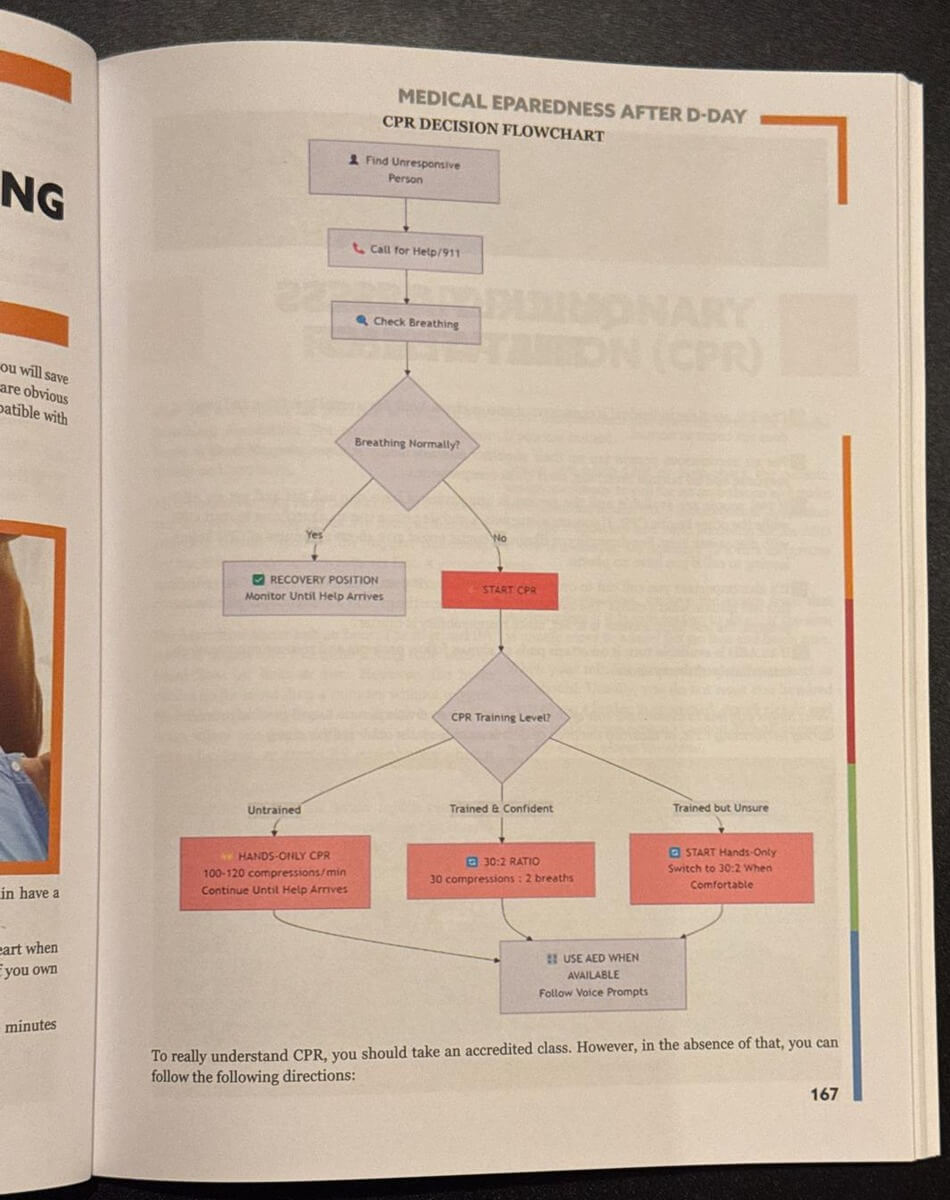
Yes. Survival MD has a CPR Decision Flowchart (p. 167): a single page of boxes and arrows that starts with "Find Unresponsive Person" and walks you through each decision. When your mind is racing, a flowchart is far easier to follow than paragraphs.
Can you understand the steps without training?
Yes. The flowchart gives different paths depending on whether you're untrained, trained and confident, or trained but unsure. That's a detail most first-aid material ignores, and it means the book meets you where you are. The text after the flowchart explains the modern CAB sequence, and a Myth vs. Fact box corrects a mistake people make constantly: doing compressions on a bed or couch, where the soft surface absorbs the force. There are separate sections for children and babies, and for choking.
Does it tell you when to stop?
Yes. Before anything else, the book tells you to make sure the scene is safe and to get someone calling for help and bringing an AED if there is one. It's honest that CPR is best learned in an accredited class, and it explains how to recognize signs of shock and when to keep going until help arrives.
Score: 3 out of 3
Situation 3: A Winter Blackout and a Family Member With Diabetes
Picture itA storm knocks out power for days. The roads are icy, the pharmacy is closed, and your father, who has diabetes, is running low on supplies.
This is the kind of emergency most first-aid books don't even mention. Survival MD handles it in detail.
Can you find the answer fast?
Yes. Diabetes has its own section in the chapter on chronic conditions (pp. 40–43), and the table of contents lists it under "Metabolic Diseases."
Can you understand the steps without training?
Yes. The book uses a color-coded supply plan: Green, Yellow, Orange and Red. It tells you what to do as insulin, test strips, ketone strips, glucagon and fast-acting carbs run low. There's also a symptom-based zone chart, so you can match what you see in the person to what you should do. Practical safety notes cover things like keeping insulin at the right temperature without power, and what to keep as backup if a pump or glucose monitor fails.
Does it tell you when to stop?
Absolutely. The supply table carries a clear rule: "No Self-Tapering." The book repeats "do not ration" and "do not guess doses," and the Red level spells out exactly which signs mean you seek emergency care now. That's precisely what you want from a book in a situation where a wrong guess could be dangerous.
Score: 3 out of 3The full zone charts and supply plans are in the book. We cover them in how Survival MD handles chronic disease.
The Scorecard
Deep cut, heavy bleeding
- Find it fast: chapter heading + index
- Understand it: short steps, safety note, myth box
- Know when to stop: trained-only warnings, red flags
Someone collapses
- Find it fast: one-page CPR flowchart
- Understand it: paths for every training level
- Know when to stop: scene safety, call for help, AED
Diabetes in a blackout
- Find it fast: dedicated section
- Understand it: color-coded supply plan
- Know when to stop: "No self-tapering," clear Red level
Three situations, nine checks, nine passes.
Why Survival MD Works When Other Books Don't
It's designed for stress, not for reading. Big chapter titles, 8 decision flowcharts, checklists and short steps mean you can use it with shaking hands.
It's written by a surgeon who knows the limits. Dr. Scurtu built the book on the principle first, do no harm. Every section tells you what you can safely do and where to stop.
It covers more than injuries. Chronic illness, children, dental emergencies, infections and medications are all in one book, because real emergencies aren't limited to cuts and broken bones.
It works without power. A printed book doesn't need a battery, a signal or a login, which matters most in exactly the situations above. More on that in print vs. digital.
It stops the mistakes that make things worse. Seventy Myth vs. Fact boxes correct the instincts and old advice that cause harm.
What Survival MD Doesn't Promise
To be fair, a book has limits, and Survival MD is honest about them:
- It doesn't replace a doctor or emergency services. When help is available, call 911.
- It doesn't replace hands-on practice. A CPR or STOP THE BLEED class plus the book is the strongest combination.
- It won't help if it's still in the box. Read the chapters that matter most to your family before you need them.
None of that is a weakness of the book. It's what any responsible medical guide should tell you, and Survival MD tells you clearly. For a full list of strengths and drawbacks, see Survival MD pros and cons.
Frequently Asked Questions
Does Survival MD really work?
Yes, in the way a medical book should: it helps you find the right information fast, follow the steps without medical training, and recognize when a situation needs professional care. We tested it on bleeding, a collapse requiring CPR and diabetes during a blackout, and it passed on all three counts each time.
Can someone with no medical training use Survival MD?
Yes. It's written in plain English with flowcharts, checklists and short steps, and some sections, like the CPR flowchart, give different paths depending on your training level.
Does Survival MD cover emergencies other than injuries?
Yes. It covers chronic conditions like diabetes, heart and lung disease, as well as infections, sudden illness, dental emergencies, children's medicine and medication stockpiling.
How quickly can I find information in an emergency?
Quickly. Every major topic has a large chapter heading, the book includes 8 decision flowcharts, and there's a detailed index at the back.
What if it doesn't work for me?
You have 60 days to request a refund, and you keep the book and the four bonus guides anyway.
The Verdict
Does Survival MD work? Judged the way a medical book should be judged, by how fast you find the answer, how easily you follow it and how clearly it tells you where to stop, the answer is yes.
You've seen how it handles three situations. Inside, there are 150+ more topics built the same way, ready for the moment you hope never comes. For everything else in the book, read our complete Survival MD review.