Pros and Cons at a Glance
Pros
- Written by a surgeon, in plain English
- Made for situations where you can't reach a doctor
- Works with no power, signal or battery
- Flowcharts, checklists and big headings for fast use
- Covers the whole family: kids, women, chronic illness, teeth
- 70 "Myth vs. Fact" boxes that prevent common mistakes
- 147-item home inventory with exact quantities
- 4 bonus guides and a 60-day keep-everything guarantee
- Just $37
Cons
- It's a physical book, not an instant download
- It's long: 280+ pages
- It's cautious and often says "only if trained"
- It won't replace hands-on practice
- It shows you how unprepared you really are
- Some chapters you'll hope you never open
- It's written for American readers
That's the quick version. The interesting part is what each point means in real life, especially the cons.
The Pros
1. A surgeon wrote it, for people who aren't doctors
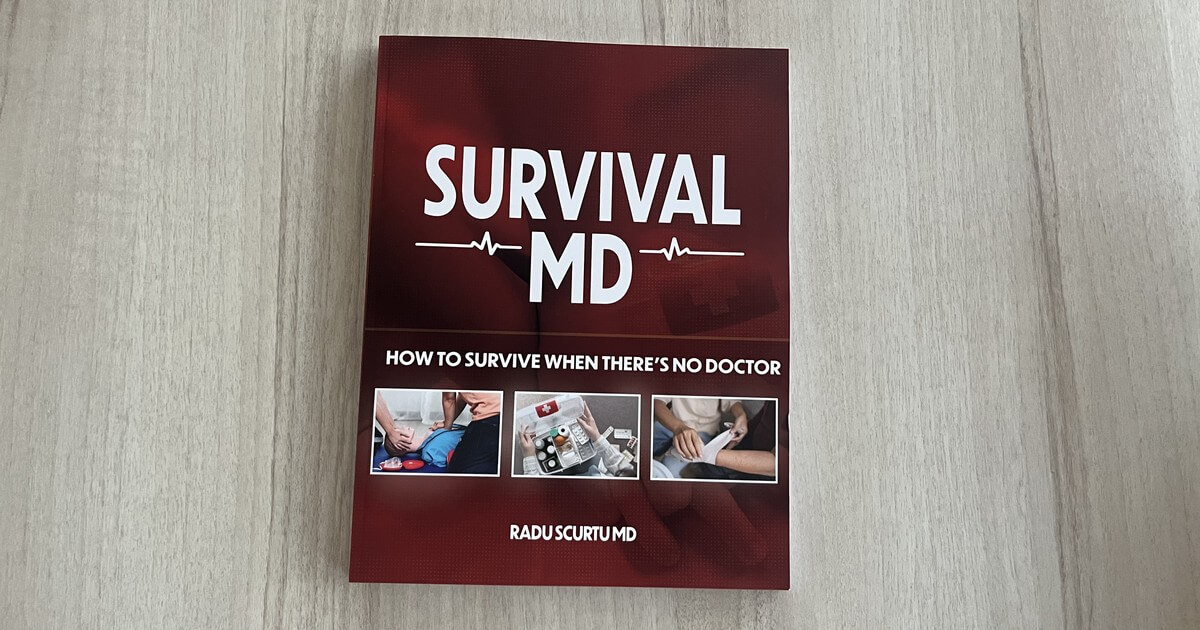
Survival MD is written by Dr. Radu Scurtu, a surgeon who learned medicine in overloaded hospitals where equipment and staff were often in short supply. That experience shows. The book focuses on decisions you can make with what you have, explained in plain language rather than medical jargon.
2. It's built for the moments when no doctor is coming
Most first-aid material stops at "call for help." Survival MD is designed for what happens next: when the ambulance is far away, the ER is overwhelmed, or a storm, blackout or cut-off road means you can't reach medical care at all.
3. It works when everything else fails
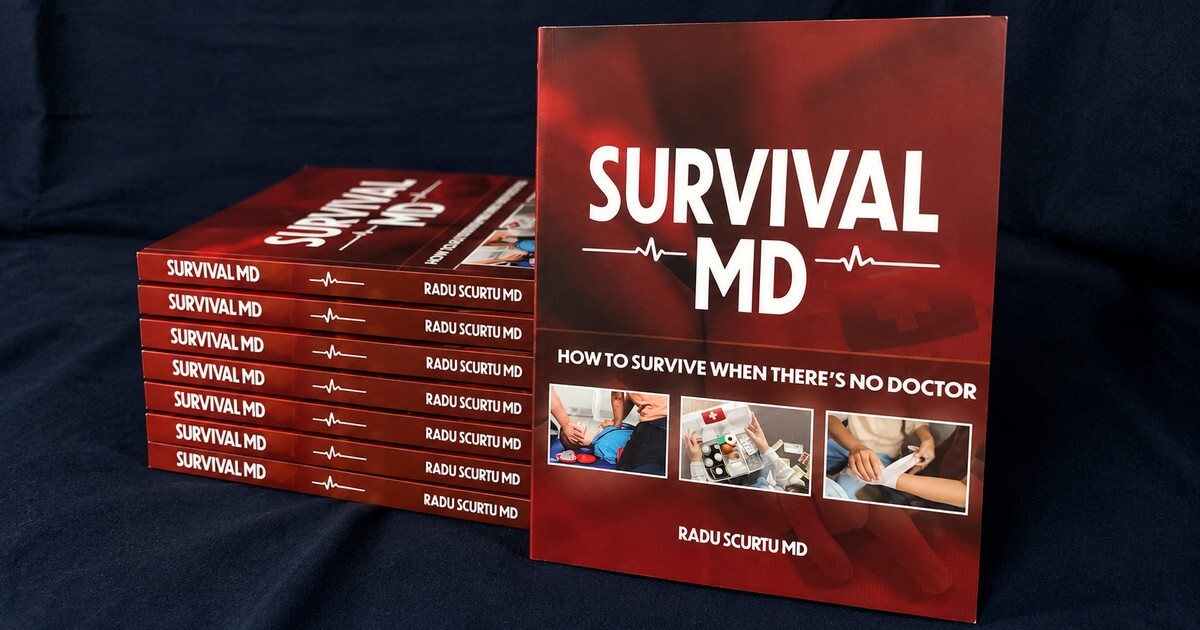
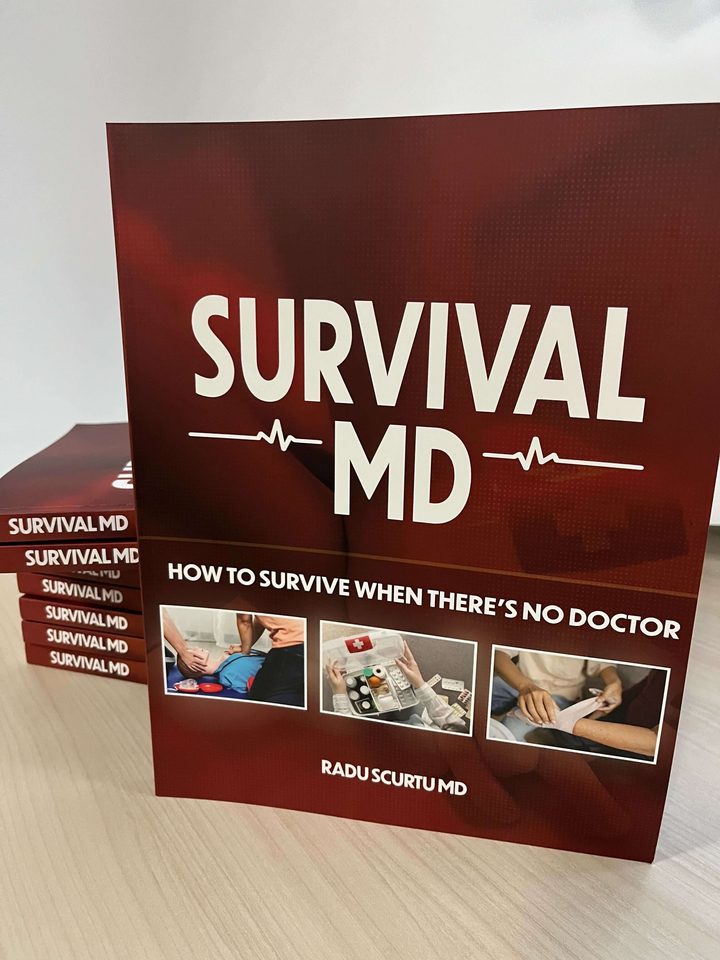
It's a printed, full-color book. No battery to die, no signal to lose, no app to update. Open it in a blackout, a basement, a car or a cabin.
4. It's laid out for real emergencies
Big chapter titles, step-by-step flowcharts, checklists and short instructions make it possible to find the right page and follow it under pressure, not just read it on a quiet evening.
5. It covers the whole household
Beyond injuries, it covers topics most survival books skip: children's medicine and baby CPR, women's health and pregnancy, chronic conditions and daily medications, and even dental emergencies.
6. It stops the mistakes that make things worse
There are 70 "Myth vs. Fact" boxes throughout the book, each one correcting a common instinct or old piece of advice that can do more harm than good.
7. It tells you exactly what to keep at home
The 147-item Master Inventory gives you a checklist split into four kits, color-coded by priority, with quantities for two adults and a child for 30 days.
8. The extras and the guarantee are generous
Your order includes four digital bonus guides (children's emergencies, home medicine reserves, herbal first aid and pet emergencies). There's also a 60-day refund window where you keep the book and bonuses even if you ask for your money back.
9. The price
$37 for all of it. That's less than most first-aid classes and a tiny fraction of a single emergency room visit. We break the numbers down in Is Survival MD worth the money?
The Cons (and Why They're Not What They Seem)
No book is perfect, and we'd be doing you a disservice if we pretended otherwise. Here's what some buyers might not love about Survival MD, and what each point actually means once you think it through.
Con #1: It's a physical book, not an instant download
The downside: You can't click "buy" and start reading the main book a minute later. It has to be printed and shipped to you.
Why it works in your favor: That's exactly the point. A download lives on a phone or laptop, and those are the first things to fail in a real emergency. A printed book sits on your shelf, ready, whether or not the power is on. And the four bonus guides are digital, so you have something to read while the book is on its way.
Con #2: It's long, with 280+ pages
The downside: This isn't a pamphlet you finish in an afternoon. It's a full manual, and some sections are dense.
Why it works in your favor: You're not supposed to read it like a novel. It's built to be looked up, with large chapter titles and flowcharts that take you straight to what you need. The length is what lets it cover 150+ topics instead of the same dozen every basic first-aid booklet repeats. Read one chapter a week and you'll know the book well within a few months.
Con #3: It's cautious, and often says "only if trained"
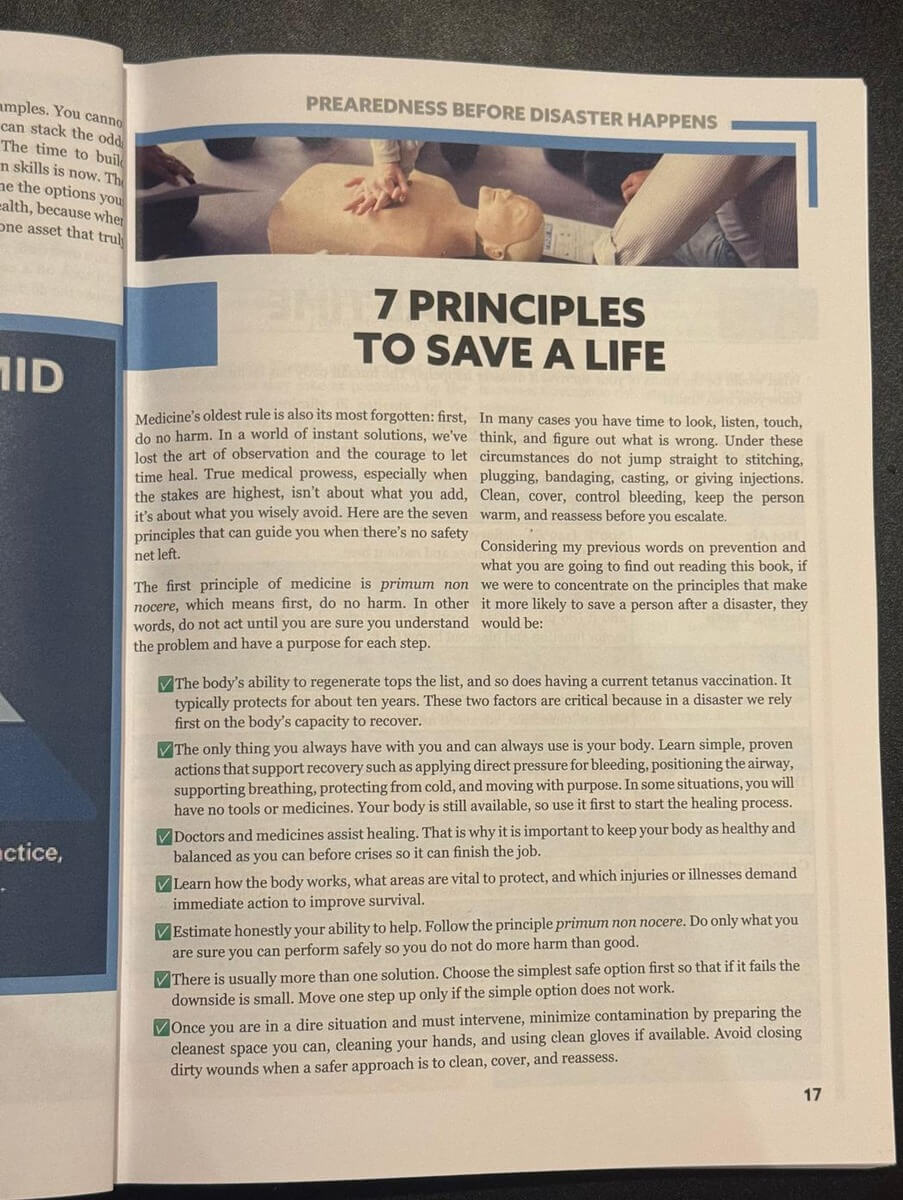
The downside: If you're hoping for a book that promises you can handle anything alone, this isn't it. Survival MD regularly tells you when something is beyond home care, or when a technique should only be used by someone with training.
Why it works in your favor: That caution is the book's biggest strength. It's written around the oldest rule in medicine, first, do no harm. A guide that tells you what not to do is far safer than one that encourages heroics. And knowing your limits is precisely what keeps a bad situation from getting worse.
Con #4: It won't replace hands-on practice
The downside: You can't learn the feel of chest compressions or applying pressure from a page alone.
Why it works in your favor: No book can, and Survival MD doesn't pretend to. But classes have their own problem: research shows CPR skills start fading within about three months. The book is what stays when the class is a distant memory. Take a course for your hands, keep Survival MD for everything you'll forget, and you have the best of both.
Con #5: It shows you how unprepared you really are
The downside: Going through the book can be uncomfortable. Most readers realize their first-aid kit is thin, their medicine cabinet is full of expired bottles, and they don't have a plan if someone in the family gets badly hurt.
Why it works in your favor: Better to find that out on a quiet evening than at 2 a.m. with someone bleeding on the kitchen floor. And the book doesn't just point out the gaps. Its 147-item inventory, with priorities and quantities, shows you exactly how to fill them, starting with what's critical.
Con #6: Some chapters you'll hope you never open
The downside: Sections on serious trauma, deep wounds or radiation exposure aren't light reading, and most families will never need them.
Why it works in your favor: You don't have to read them today. But if the worst ever happens, it's already on your shelf. A medical guide that skips the hard scenarios fails you exactly when you need it most. Survival MD covers them, so you don't have to go looking when there's no time.
Con #7: It's written for American readers
The downside: Medication names, emergency numbers and some rules are based on the U.S. Readers elsewhere may need to look up local equivalents.
Why it works in your favor: If you live in the U.S., that's a plus. The medications it names are the ones you'll actually find at your pharmacy, and the advice fits the system you live in. And the core of the book, from assessing an injury to stopping bleeding and recognizing danger signs, works the same anywhere in the world.
Who Will Love It and Who Might Not
You'll love Survival MD if you:
- Want a clear plan for when someone in your family is hurt or sick and help is far away
- Prefer a physical reference you can rely on without a phone or internet
- Like being organized: checklists, priorities, quantities
- Have kids, care for someone with a chronic condition, or live far from a hospital
It may not be for you if you:
- Want a five-minute read rather than a reference book
- Are a doctor or paramedic looking for an advanced clinical manual
- Only want digital content and never use printed books
Even then, there's a 60-day refund, and you keep the book either way.
Frequently Asked Questions
What are the main pros of Survival MD?
It's written by a surgeon for non-medical readers, it's designed for situations where you can't reach a doctor, it works without power or internet, and it covers the whole family, with 70 Myth vs. Fact boxes, a 147-item home inventory and four bonus guides, all for $37.
What are the cons of Survival MD?
It's a printed book that has to be shipped, it's long (280+ pages), it's cautious about advanced procedures, it doesn't replace hands-on training, and it's written for U.S. readers. For most buyers, these turn out to be strengths rather than weaknesses.
Is Survival MD hard to read?
No. It's written in plain English for people without medical training. It's long because it covers a lot, but the chapter titles, flowcharts and checklists make it easy to find what you need.
Does Survival MD replace a first-aid course?
No, and it's best combined with one. But skills from a course fade within months, while the book stays on your shelf for years.
Is there a risk in buying it?
Very little. You have 60 days to ask for a refund, and you keep the book and the bonus guides anyway.
Our Verdict
The pros are exactly what you'd want from a home medical guide: a surgeon's knowledge, a format that works when nothing else does, and coverage for everyone in the house. The cons, looked at closely, mostly describe a book that's thorough, careful and honest about its limits.
That's the kind of book you want on your shelf when it matters. For the full picture, read our complete Survival MD review.