An Honest Answer to a Fair Question
When people ask what a book doesn't cover, they're usually trying to find the catch. So let's answer it directly.
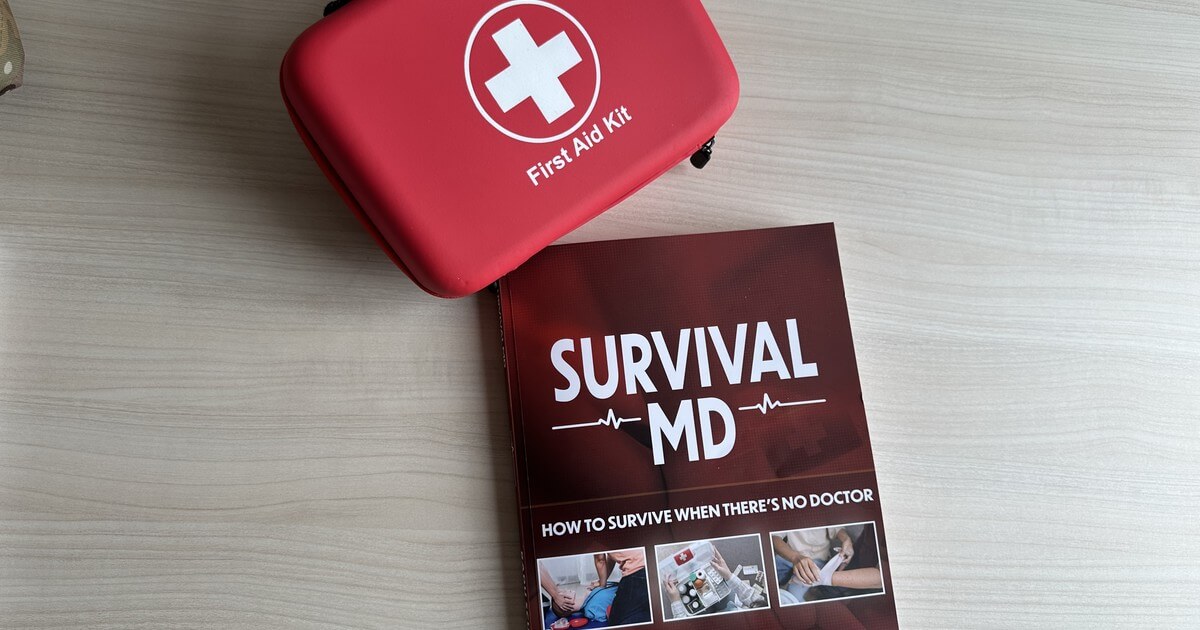
On the knowledge side, Survival MD by Dr. Radu Scurtu covers just about everything a family needs when a doctor can't be reached: from preparing your home before a disaster to handling bleeding, fractures, burns, infections, chronic illness, CPR and what to do when prescriptions run out. We looked hard for gaps, and in terms of what to know, there are very few.
But there's one thing no book in the world can give you, and Survival MD is honest enough to say so itself: the feel of doing it with your own hands.
That's what this article is about: what Survival MD covers, the few things no book can replace, and the perfect combination that lets you safely apply absolutely everything in the book.
First, What Survival MD Does Cover
Before we talk about gaps, here's the scope. Across 19 chapters, 280+ pages and 150+ topics, the book covers:
| Area | What's included |
|---|---|
| Preparing before a disaster | Prevention mindset, chronic disease plans, dental emergencies, women's health and pregnancy |
| Supplies | Medications to stockpile and rotate, hygiene, the Lifeline Kit, response kits, the 147-item Master Inventory |
| Natural options | Herbal remedies for 14 common problems, with safety flags and "when to get help" lines |
| Sanitation | Toilets, waste, handwashing stations and safe water storage |
| When there's no doctor | Assessment, the TeCaMoLo Principle, body checks, triage and "Moment X" |
| Emergencies | CPR for adults, children and babies, shock, choking, bleeding, wounds, fractures, burns and trauma to every part of the body |
| Illness | Infections, heat and cold, heart attack and stroke, abdominal emergencies, radiation |
| The long haul | Climate-specific risks and how to survive without prescriptions |
It's backed by 350+ references to sources like the CDC, FDA, NIH and the American Heart Association, with 8 flowcharts, 70 Myth vs. Fact boxes and 50+ Clinical Safety Notes.
If your question is "Does it cover the emergency I'm worried about?", the answer is almost certainly yes.
The One Thing No Book Can Cover: Your Hands
Reading how to do chest compressions is not the same as doing them. You can know the right rate and depth from the page, but you only learn how hard to push, how tiring two minutes really is and how it feels to keep going under stress by practicing on a training mannequin.
The same is true for packing a wound, applying a tourniquet, splinting a limb or giving rescue breaths. These are physical skills. They live in your hands as much as in your head.
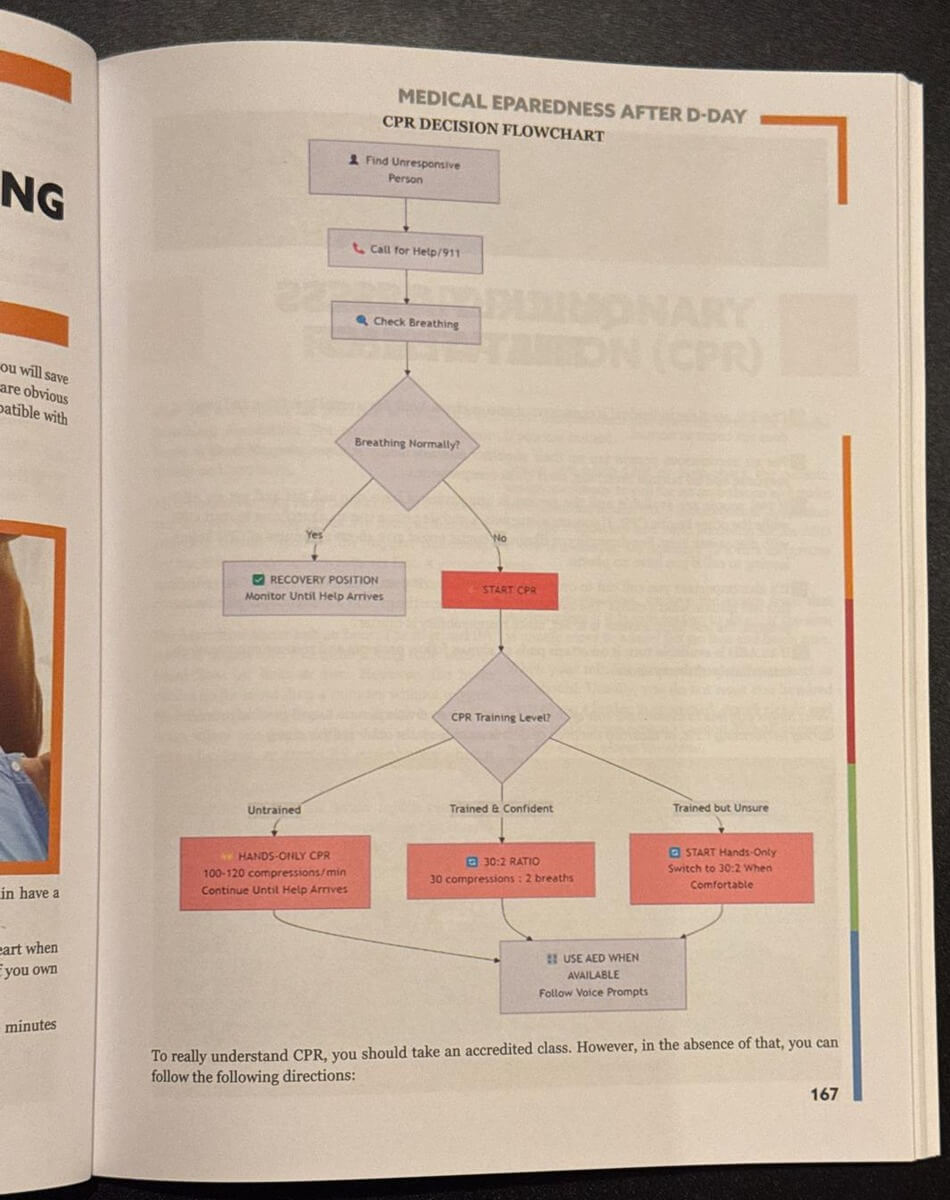
Survival MD is completely open about this. In its CPR chapter, Dr. Scurtu writes:
"To really understand CPR, you should take an accredited class."
Survival MD, Chapter 14
And the book's CPR guidance is built around your training level, with different steps for people who are untrained, trained and confident, or trained but unsure.
Other Things a Book Can't Do (and What Survival MD Does Instead)
To be completely fair, here are the other limits that apply to any book, and how Survival MD handles each one:
It can't write you a prescription
No book can. What Survival MD does is show you how to plan with your doctor in advance: what to stockpile, how to rotate it, which medicines must never be stopped suddenly and how to prepare for the day the pharmacy is closed.
It can't replace a hospital's equipment
Surgery, X-rays, lab tests and advanced life support need professionals and machines. Survival MD focuses on what an ordinary person can do safely, and clearly marks what should wait for professional care.
It can't give you a certificate
Some jobs and volunteer roles require official first aid or CPR certification. A book can't provide that, but a course can.
It can't practice with you
A book can't correct your hand position or tell you to push harder. That's exactly what an instructor is for.
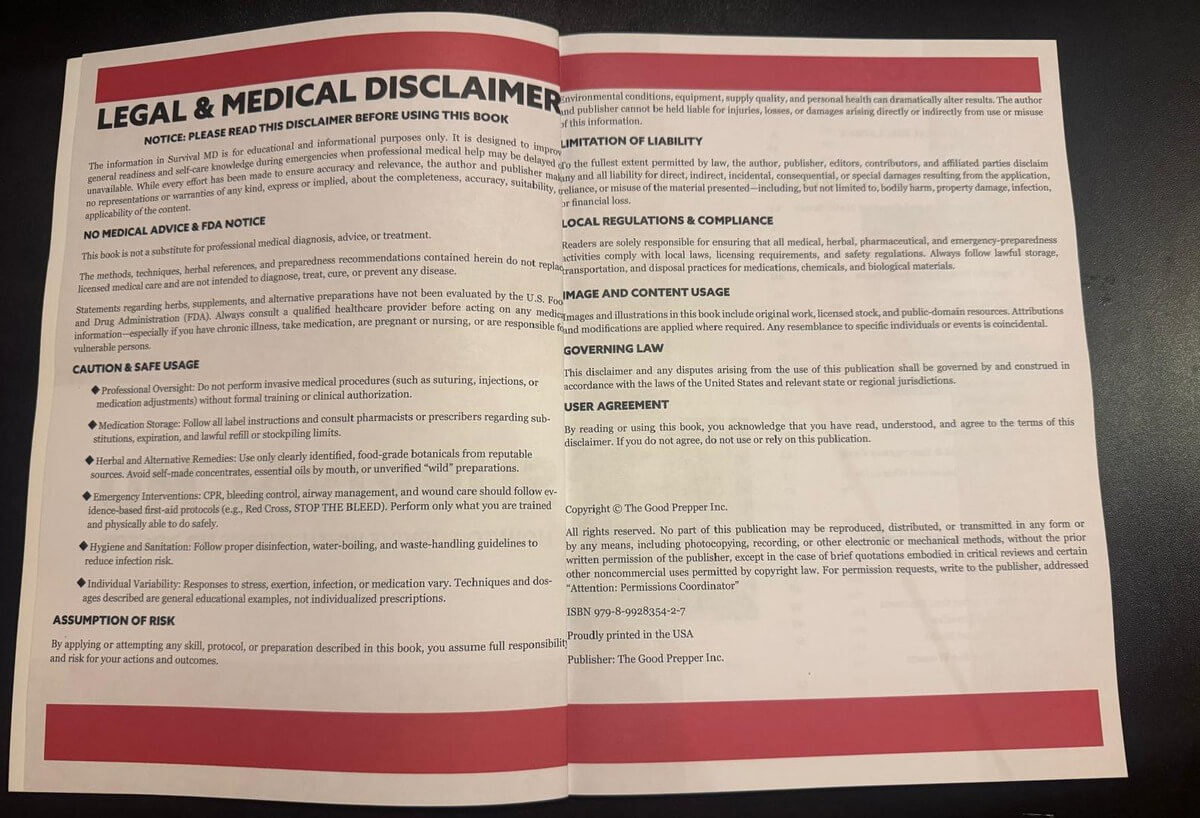
Notice the pattern? None of these are gaps in knowledge. They're the natural limits of reading. And the book itself points you to the solution, right on its first pages:
The Perfect Combination: Survival MD + Hands-On Training
Here's how we see it: Survival MD gives you the knowledge. A hands-on course gives you the muscle memory. Together, they let you safely apply everything in the book.
| What Survival MD teaches you | The hands-on course that makes it second nature |
|---|---|
| CPR for adults, children and babies, and using an AED (Chapter 14) | A CPR/AED course, such as those from the American Red Cross or the American Heart Association (Heartsaver) |
| Stopping serious bleeding, wound packing and tourniquets (Chapters 10 and 15) | A Stop the Bleed course from the American College of Surgeons |
| Wounds, burns, sprains, fractures and splinting (Chapters 8, 10 and 15) | A general First Aid course |
| Choking relief and CPR for children and infants (Chapter 14) | A pediatric first aid and CPR course, ideal for parents and grandparents |
| Caring for someone for days when help is far away (Chapters 12–17) | A wilderness or remote first aid course, great for rural families, hikers and campers |
Many of these courses take just a few hours, and some, like Stop the Bleed, are often offered for free or at low cost by hospitals and community organizations. Check what's available near you.
Which Should Come First: The Book or the Course?
Our recommendation:
- Read Survival MD first. You'll walk into the class already understanding the why, so you'll get far more out of it and know exactly what questions to ask.
- Take a hands-on course. Practice the physical skills with an instructor.
- Keep the book as your reference. A class lasts a few hours. Survival MD stays on your shelf, ready for every topic the class didn't have time for and every detail you forget months later.
- Refresh both. Reread the chapters that matter most for your family, and renew your training when your certification expires.
Why the Course Alone Isn't Enough Either
The perfect combination works both ways. A typical first aid course is built around the first few minutes before an ambulance arrives. It usually doesn't cover chronic illness, medications, dental emergencies, sanitation, infections, triage for several injured people or what to do when help doesn't come for days.
That's exactly where Survival MD takes over. More here: I Already Took a First Aid Class. Do I Still Need This?
Who Benefits Most From the Combination
- Parents and grandparents: pair the book with a pediatric CPR and first aid class.
- Rural families: pair it with a wilderness or remote first aid course.
- Caregivers of someone with a chronic condition: pair Chapter 2 and Chapter 19 with a conversation with your loved one's doctor.
- Anyone who's never had training: start with the book, then take one CPR/AED class. Even one class makes a big difference.
And if you never take a class? Survival MD is still written so a non-medical person can follow it safely, with clear "if trained" markers and guidance on what not to attempt. More here: Can You Use Survival MD Without Medical Training?
Frequently Asked Questions
What doesn't Survival MD cover?
On the knowledge side, very little: it covers preparation, supplies, emergencies, illness and long-term care across 19 chapters. What no book can provide is hands-on practice, prescriptions, hospital equipment or official certification.
Does Survival MD replace a first aid or CPR course?
No, and it doesn't claim to. The book recommends taking an accredited CPR class. The best approach is to combine the book's knowledge with hands-on training.
Which course should I take with Survival MD?
Start with a CPR/AED course. Then consider Stop the Bleed, a general first aid course, pediatric first aid if you have children, or wilderness first aid if you live far from help.
Should I read the book before or after the course?
Before is ideal, because you'll understand more in class. Then keep the book as your long-term reference.
Can I use Survival MD without taking a course?
Yes. It's written for non-medical readers, with clear steps and safety notes. A course simply helps you apply the physical skills with more confidence.
The Bottom Line
What does Survival MD not cover? In terms of knowledge, almost nothing a family needs in a medical emergency. What it can't do is put the skills into your hands. That's why the perfect combination is simple: Survival MD for everything you need to know, plus a hands-on course for the skills you need to practice. Together, they let you apply everything in the book safely and confidently.
Start with the book. It's the foundation for everything else.